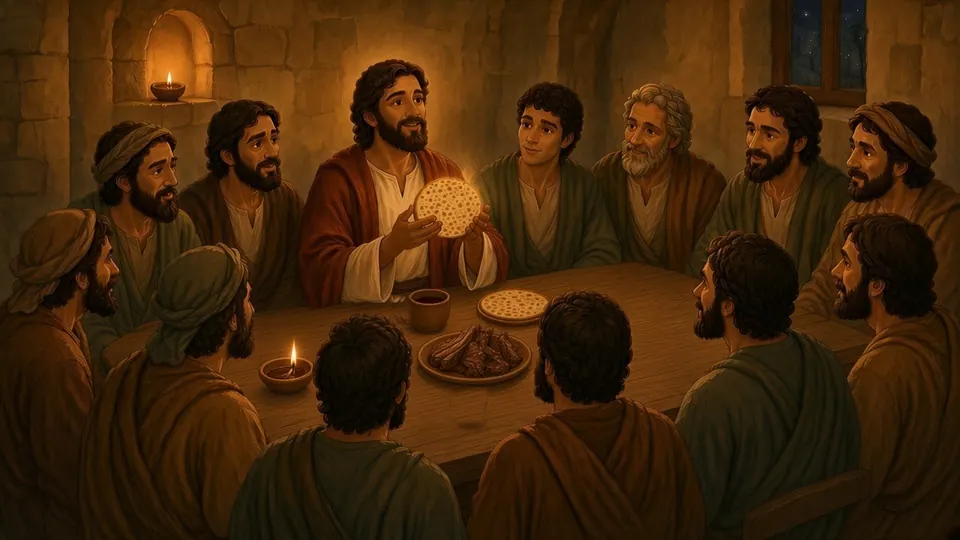
The Last Supper
Luke 22:7–20
On the night before he died, Jesus gathered the Twelve for the Passover. Luke places it on the day the lambs were sacrificed; Peter and John prepare a large upper room. Paul, handing on a tradition he had received and passed on within about twenty-five years of the event, sets the scene simply: on the night he was betrayed (1 Cor 11:23). Matthew, Luke and Paul agree on the essential words.
The context is the liturgy of liberation. Passover recalled the lamb's blood on the doorposts, the angel passing over, the exodus from slavery (Ex 12). Into that memorial Jesus speaks words that redefine it. Over the bread: his body, given for them, with the command to repeat it in his memory. Over the cup after supper: the new covenant sealed in his blood, poured out for them, or in Matthew's wording, for many, for the forgiveness of sins (Mt 26:28). He also says he will not eat the Passover again until it is fulfilled in the Kingdom of God, pointing beyond the meal to the cross, the Resurrection and the heavenly banquet.
The Church's reading is precise.
The Supper and the cross are one offering. At the Supper Jesus anticipated the free offering of his life (CCC 610) and included the apostles in it, commanding them to perpetuate it (CCC 611). The Eucharist is therefore the memorial of his sacrifice, not in the weak sense of a recollection but as making present the sacrifice of Christ, offered once for all (CCC 1366).
Christ's presence is real and substantial. Not merely symbolic and not merely spiritual: the whole Christ, Body, Blood, soul and divinity, is present under the species (CCC 1374), by the conversion the Church calls transubstantiation (CCC 1376). Reverence follows: the Church adores the Eucharist both during Mass and outside it.
The Passover is fulfilled. By celebrating the Last Supper within the Passover meal, Jesus gave the Jewish Passover its definitive meaning: his own passing over to the Father by his death and Resurrection, anticipated in the Supper and celebrated in the Eucharist (CCC 1340). And the Church keeps the command to repeat it until he comes (CCC 1341).
The priesthood is instituted. Do this is addressed to the apostles. In it the Church recognizes the institution of the priesthood of the New Covenant (CCC 611, 1337).
Thanksgiving is at the center. Jesus gave thanks over the bread (CCC 1328). The Greek word, eucharistein, gives the sacrament its name.
For adult life:
The Mass is not ours to redesign. It is his gift, received and handed on, as Paul insists.
Real presence calls for real preparation: the Eucharistic fast, examination of conscience, Confession if needed, and a moment of silence before and after Communion.
Jesus gave thanks on the night he was betrayed. Gratitude is not a mood for good days only; it is how he faced the worst one.
A real-life step: spend fifteen minutes in Eucharistic adoration this week, and simply thank him.
Talk about it
- What does it mean to you that Jesus gave thanks on the night he was betrayed?
- How does the Church's teaching that the Mass makes present Christ's one sacrifice shape how you participate?
- How would you explain transubstantiation, simply and accurately, to a curious coworker?
- What concrete preparation could deepen your next reception of Communion?
Key verse: 1 Cor 11:23–26. Look it up in your Bible.
Illustrations created with Grok (AI) and reviewed by our team. Narration voice: Kokoro TTS (AI), Apache 2.0.