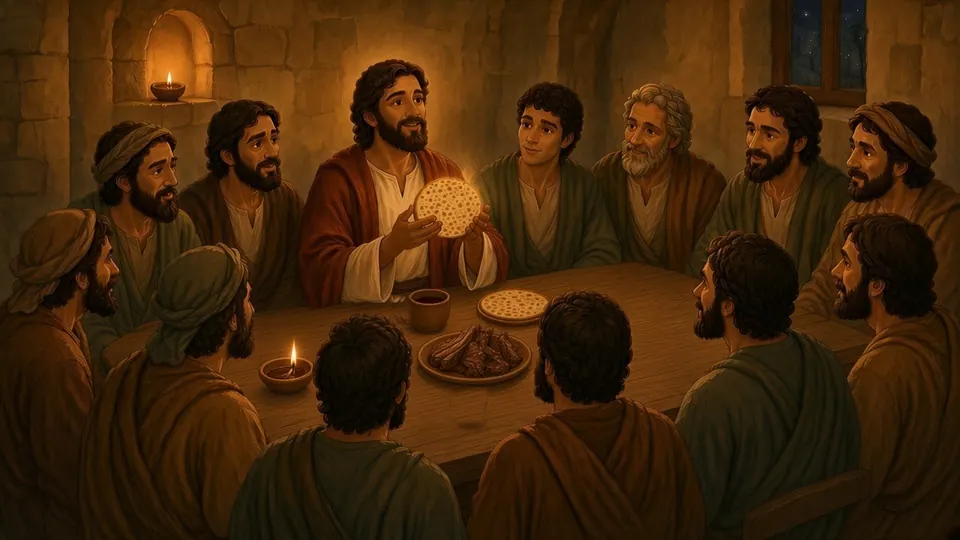
The Last Supper
Luke 22:7–20
Passover was the greatest feast of the Jewish year. Families ate roasted lamb, unleavened bread and bitter herbs and drank cups of wine, retelling how God had freed Israel from Egypt. The blood of the lamb had marked their doors, and God had saved them (Ex 12).
Luke tells us that on the day the Passover lambs were sacrificed, Jesus sent Peter and John into Jerusalem. They would meet a man carrying a jar of water and follow him to a house with a large furnished upper room. Everything happened as Jesus said, and they prepared the meal.
At table with the apostles, Jesus told them how deeply he had wanted to eat this Passover with them before his suffering. Then, in the middle of a meal that remembered the old rescue, he began something new.
He took bread, gave thanks, broke it and gave it to them, saying it was his body given for them, and told them to do this in remembrance of him. After supper he took the cup and called it the new covenant in his blood, poured out for them.
Matthew records the same words over the cup, adding that the blood is poured out for many for the forgiveness of sins (Mt 26:28). St. Paul, writing to the Corinthians only about twenty-five years later, passes on the same account he had received, and adds that whenever we eat this bread and drink this cup, we proclaim the Lord's death until he comes (1 Cor 11:23–26).
What did Jesus give them? The Church has always believed that Jesus meant exactly what he said. In the Eucharist, Christ is truly, really and substantially present, Body and Blood, soul and divinity (CCC 1374). It is not just a symbol. The bread and wine are changed, even though they still look and taste the same. The Church calls this change transubstantiation (CCC 1376).
Why at Passover? Because Jesus is the true Passover Lamb. His death on the cross the next day would free us not from Egypt but from sin and death. At the Last Supper he gave the apostles his sacrifice ahead of time, and the Mass makes that same one sacrifice present today (CCC 1366).
When Jesus said, Do this, he gave the apostles the power and the duty to celebrate the Eucharist. That is why the Church says that at the Last Supper Jesus also gave us the priesthood (CCC 611).
Talk about it
- How does the Passover help us understand what Jesus did at the Last Supper?
- What does the Church mean when it says Jesus is really present in the Eucharist, not just in a symbol?
- Why do you think Jesus chose a meal to give himself to us?
- What does Jesus' command to repeat this meal in his memory ask of us today?
Key verse: Lk 22:19–20. Look it up in your Bible.
Illustrations created with Grok (AI) and reviewed by our team. Narration voice: Kokoro TTS (AI), Apache 2.0.