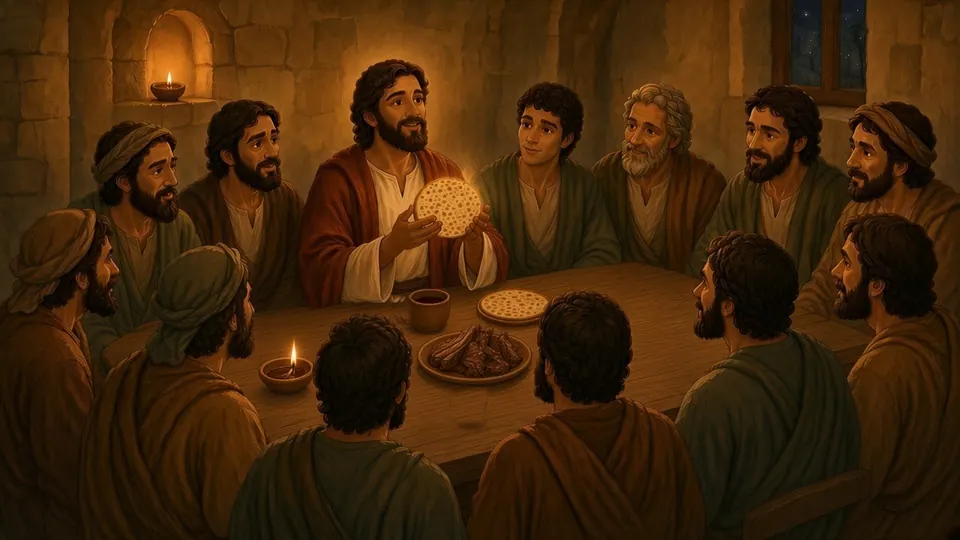
The Last Supper
Luke 22:7–20
The Synoptic Gospels and St. Paul give us four accounts of one night. Paul's is the oldest written form: writing to Corinth around AD 55, he hands on what he received from the Lord, that on the night he was betrayed Jesus took bread, gave thanks (CCC 1328), broke it and called it his body, and did the same with the cup, the new covenant in his blood (1 Cor 11:23–26). Luke's account agrees closely with Paul's; Matthew's (Mt 26:26–29) adds that the blood is poured out for many for the forgiveness of sins.
The setting is Passover. Luke notes it was the day the lambs were sacrificed. Jesus sends Peter and John to prepare the meal in a large upper room. At table he tells the Twelve he has longed to share this Passover meal with them before he suffers, and that he will not eat it again until it is fulfilled in the Kingdom of God.
Then, within the old memorial of Israel's liberation, he does something unheard of. He identifies the bread with his body given for them and the cup with the new covenant in his blood, echoing Jeremiah's promise of a new covenant (Jer 31:31) and Moses' blood of the covenant at Sinai (Ex 24:8). And he commands them to repeat it as his memorial.
The Church's understanding rests on three points.
First, the Eucharist was instituted here as the memorial of his sacrifice. Jesus' offering on the cross was, so to speak, given in advance at the Supper (CCC 610). The Mass is not a new sacrifice and not merely a reminder. It makes present the one sacrifice of the cross (CCC 1366).
Second, Christ is really present. The Catechism says that in the Eucharist the Body and Blood, together with the soul and divinity, of Christ, and therefore the whole Christ, is truly, really and substantially contained (CCC 1374). The Council of Trent named the change of substance transubstantiation (CCC 1376). To call the Eucharist only a symbol is not Catholic faith.
Third, the command to do this is also the institution of the priesthood of the New Covenant: Jesus made the apostles priests so that they could carry it out (CCC 611, 1337).
The Passover is given its full meaning. Israel's Passover looked back to the Exodus; Jesus' Passover, his passing over through death to the Father, brings that hope to completion (CCC 1340).
The very name Eucharist means thanksgiving: at the heart of the night of his betrayal, Jesus gave thanks.
Talk about it
- Why does it matter that Paul's account, written so early, agrees with the Gospels?
- How do Jeremiah 31 and Exodus 24 help explain the new covenant in Jesus' blood?
- What would you say to a friend who says Catholics believe the Eucharist is just a symbol?
- How does knowing that the Mass makes present the one sacrifice of the cross change how you take part?
Key verse: Lk 22:19–20. Look it up in your Bible.
Illustrations created with Grok (AI) and reviewed by our team. Narration voice: Kokoro TTS (AI), Apache 2.0.