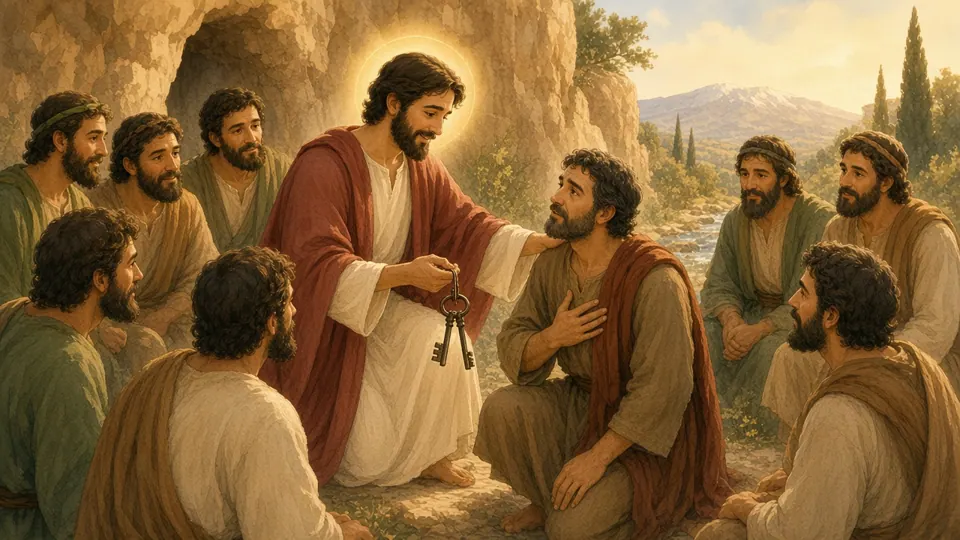
Peter and the Keys of the Kingdom
Matthew 16:13–20
Most of us were handed our answer to Jesus' question before we could think about it. Parents, a parish, a Catholic school answered for us. Caesarea Philippi is where that has to change. Jesus first asks what the crowds are saying, and the disciples have plenty to report: John the Baptist come back, Elijah, Jeremiah, a prophet. Then he asks what they think (Mt 16:13–15). Other people's opinions about Jesus, even good ones, eventually run out.
Peter's answer, that Jesus is the Messiah, the Son of the living God, earns him a blessing and a reminder: he didn't work this out by himself; the Father revealed it. Adult faith holds both halves. We are responsible for our answer, and yet the answer is a gift we receive (CCC 153). Many people who come back to the faith describe it that way. They didn't argue their way in so much as find it given.
Then Jesus builds on Peter. The name means rock, and on him Jesus founds his Church, which death will not overcome. He promises him the keys, the steward's sign of authority in the king's house (Is 22:22), and the power to bind and loose.
It is hard to read this as an adult without thinking of the Church's failures. Peter himself, a few verses later, tries to steer Jesus away from the Cross and is called a stumbling block (Mt 16:23); later he denies knowing him. Jesus didn't choose Peter because he was reliable. He chose him and then made him reliable, through failure, tears and forgiveness (Jn 21:15–17). The promise that death will not prevail rests on Christ's faithfulness, not ours. That is why the Church can survive scandal without pretending scandal isn't real. Abuse and cover-up betray the keys; they are not a use of them. The steward answers to the King.
For anyone with authority, at work, in a parish or at home, Peter is both model and warning. Authority in Christ's household is service: the steward runs the house for its owner, not for himself. Since St. Gregory the Great (pope 590–604), popes have called themselves 'servant of the servants of God'.
St. John Henry Newman (canonized 13 October 2019) spent years as a leading Anglican scholar asking, in effect, where Peter's Church was to be found now. His study of the early Church led him into full communion with the Catholic Church in 1845, at great personal cost. You don't have to share his path to learn from his honesty. He let the question change his life.
A real-life step: this week, answer Jesus' question in your own words, in writing or aloud in prayer. Not the catechism answer; yours. Then pray for the Pope, the man who holds Peter's keys now, and for your own bishop.
Talk about it
- Is your answer to 'Who is Jesus?' inherited or owned? What would help it become yours?
- How do you hold together Christ's promise to the Church (Mt 16:18) and the Church's real failures?
- Where do you hold some authority, at work or at home, and how could you use it more as service?
- Catholic connection: read CCC 881–882 on Peter and his successors.
Key verse: Mt 16:15–16. Look it up in your Bible.
Illustrations created with Grok (AI) and reviewed by our team. Narration voice: Kokoro TTS (AI), Apache 2.0.