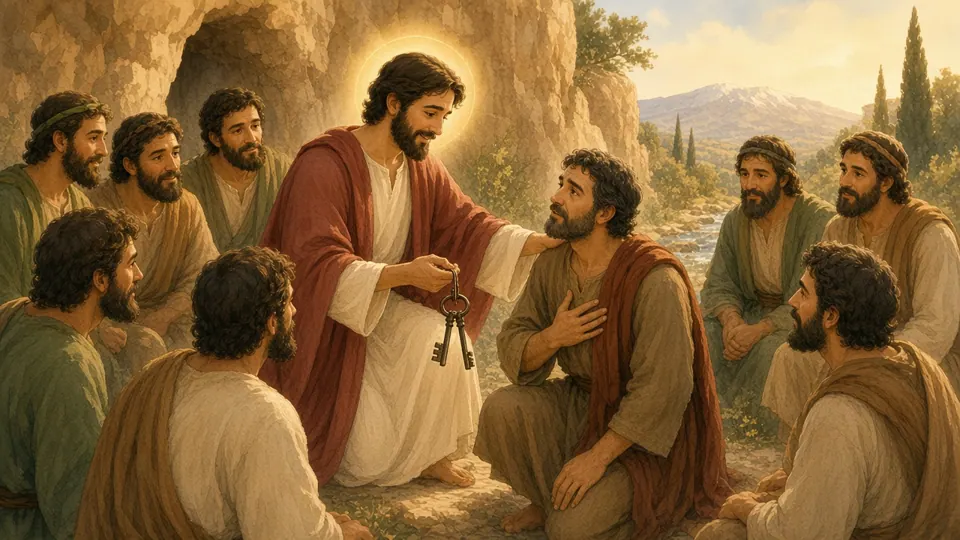
Peter and the Keys of the Kingdom
Matthew 16:13–20
Sooner or later every Christian faces the question Jesus put to the Twelve at Caesarea Philippi: not what others say about him, but what you yourself believe (Mt 16:15).
The scene: in pagan territory at the foot of Mount Hermon, Jesus asks what people are saying about the Son of Man. John the Baptist, Elijah, Jeremiah, a prophet, the disciples report. Then he asks them. Simon Peter answers that Jesus is the Christ, the Son of the living God. Jesus calls him blessed, since the Father, not any human being, revealed this. He tells Peter that he is the rock on which he will build his Church, which death will never overpower; he promises him the keys of the kingdom of heaven and the authority to bind and loose. Then he tells the disciples to keep his identity quiet for now.
Three things friends often challenge.
'Isn't the rock Peter's faith, not Peter himself?' Many Protestants read it that way, or take the rock to be Christ, and both readings appear among early Christian writers. Many Protestant scholars today agree that the rock is Peter but deny that his role passes to successors. The Catholic Church holds that the two belong together: Christ builds on Peter, the man who confesses the faith, and on the faith he confesses (CCC 424, 552). The wordplay is clearest in Aramaic, where Kepha is both the name and the word for rock (compare Jn 1:42). Many scholars explain the Greek Petros (the name) and petra (rock) as the masculine form a man's name needed.
'Where does the Bible say Peter had successors?' Not in this verse directly, and this is the main point where Catholics and Protestants part ways. But Jesus is building something meant to last, since death won't overcome it, and a steward's keys pass from one holder to the next (Is 22:20–22). The early Church recognized the bishops of Rome as Peter's successors; St. Irenaeus, writing around the year 180, listed them from the church founded by the apostles Peter and Paul onward (Against Heresies III.3). The Catechism calls the Pope the visible source of the Church's unity (CCC 882).
'Doesn't this make the Pope perfect?' No. Peter's great confession is followed at once by his attempt to talk Jesus out of the Cross, and by Jesus' sharp rebuke (Mt 16:21–23). Infallibility is a narrow gift: protection from error when the Pope solemnly defines a teaching on faith or morals for the whole Church (CCC 891). It is not personal sinlessness, and it doesn't cover his opinions.
Binding and loosing were terms Jewish teachers used for declaring things forbidden or permitted, and for excluding or readmitting people. Jesus gives this authority to Peter here and to the apostles together in Mt 18:18. The Church sees it at work in her teaching and in the sacrament of Penance, where sinners are reconciled with God and with the Church (CCC 553, 1444–1445).
Why the secrecy? 'Messiah' was easily heard as a call to revolt against Rome. Jesus first had to show what kind of Messiah he was: one who would suffer, die and rise (Mt 16:21).
Last, notice how Peter got the answer right: the Father revealed it. Faith is a gift before it is an achievement (CCC 153). Our part is to receive it and say it out loud.
Talk about it
- How would you answer a friend who says the 'rock' is only Peter's faith?
- Why does Jesus follow Peter's great confession with a rebuke a few verses later (Mt 16:23)?
- What does infallibility cover, and what does it not cover (CCC 891)?
- Who do you say Jesus is, in your own words?
Key verse: Mt 16:18–19. Look it up in your Bible.
Illustrations created with Grok (AI) and reviewed by our team. Narration voice: Kokoro TTS (AI), Apache 2.0.