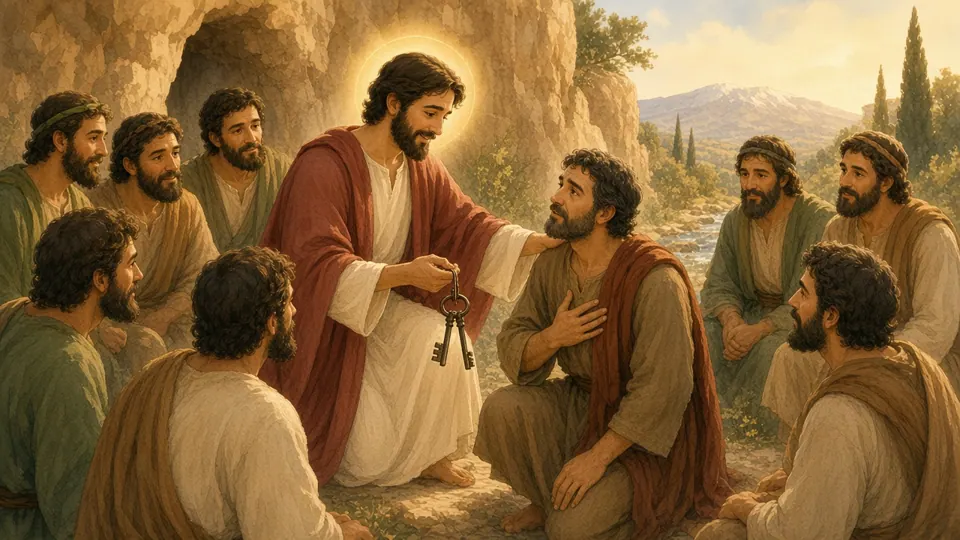
Peter and the Keys of the Kingdom
Matthew 16:13–20
Caesarea Philippi lay about 25 miles north of the Sea of Galilee, at the foot of Mount Hermon, beside a huge rock cliff where a spring flowed out. In Jesus' day it was a pagan place, with a shrine to the Greek god Pan and a temple honoring the Roman emperor. There, of all places, Jesus asks his disciples the most important question in the Gospel (Mt 16:13–20).
He starts with an easy one: what are people saying about the Son of Man? The disciples report the rumors. Some say John the Baptist, some Elijah, others Jeremiah or another prophet. All of these are compliments. None is enough.
Then he makes it personal: what do they themselves think?
Simon Peter answers for the group: Jesus is the Christ, the Messiah, the Son of the living God. Jesus calls him blessed, because this insight didn't come from human cleverness; the Father revealed it.
Then comes a play on words. In Aramaic, the language Jesus spoke, Peter's name is Kepha, which means rock (in Greek, Petros). Jesus says that on this rock he will build his Church, and death itself will never defeat it.
Then the keys. Many readers hear an echo of Isaiah 22, where God gives the key of David's palace to a new royal steward, Eliakim, with authority to open and shut its doors (Is 22:22). The king's steward ran the household in the king's name. The Church understands that by promising Peter the keys of the kingdom of heaven, Jesus makes him the steward of his Church (CCC 553).
He adds the authority to 'bind' and 'loose'. Jewish teachers used these words for forbidding and permitting, and for welcoming people into the community or keeping them out. Jesus promises that heaven will confirm those decisions. Later he gives the same power to the apostles together (Mt 18:18).
Catholics see here the beginning of the papacy. Peter is the visible rock, the foundation of the Church's unity, and the Pope, the Bishop of Rome, is Peter's successor (CCC 881–882). Most Protestant Christians read these verses differently. Many agree that Peter had a leading role among the apostles, but they do not believe his role passed to the bishops of Rome. The Church's strength doesn't come from Peter's own greatness. A few verses later Jesus has to correct him sharply (Mt 16:23), and Peter later denies Jesus three times. The rock stands because Christ promised to hold it up.
Finally Jesus orders the disciples to tell no one that he is the Messiah. Many people expected a Messiah who would drive out the Romans by force. Jesus first had to show that his path to glory ran through the Cross (Mt 16:21).
Talk about it
- Why do you think Jesus asked what people were saying before asking what the disciples thought?
- What did a king's steward do with the keys, and what does that tell us about Peter's job?
- If Jesus asked you who he is, what would you say?
Key verse: Mt 16:18. Look it up in your Bible.
Illustrations created with Grok (AI) and reviewed by our team. Narration voice: Kokoro TTS (AI), Apache 2.0.