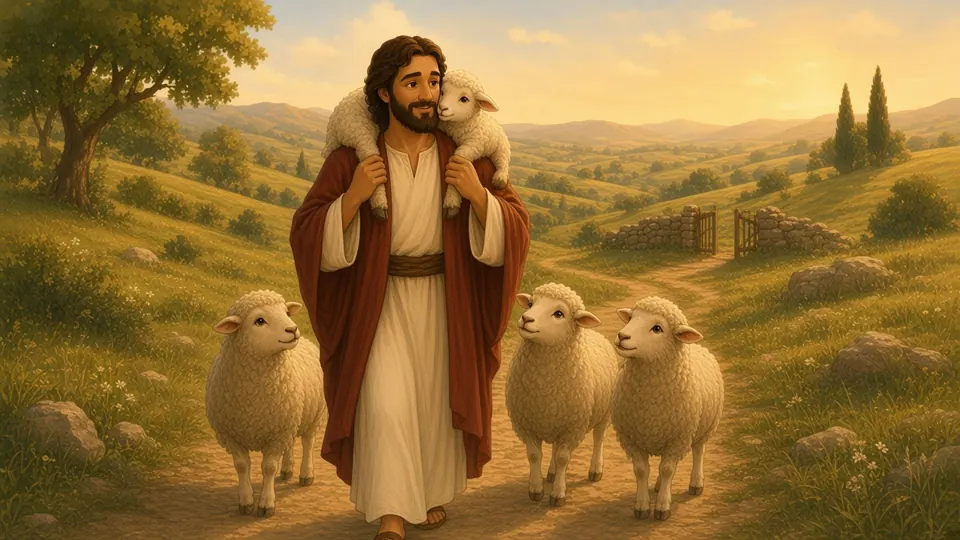
Jesus the Good Shepherd
John 10:1–18
John's Good Shepherd discourse grows out of a conflict. In chapter 9 Jesus heals a man born blind, and the authorities, instead of rejoicing, cast the man out. Chapter 10 answers that failure. Ezekiel 34 is the key: God indicts Israel's shepherds for feeding themselves and scattering the flock, and promises to shepherd his sheep himself and to raise up one shepherd, a new David, over them. Jesus' claim is therefore messianic and, in the end, divine.
The opening figure contrasts legitimate and illegitimate entry into the fold. The shepherd enters by the gate, the gatekeeper opens to him, he calls his own by name, leads them out and goes before them. The sheep follow because they know his voice. When the image is not understood, Jesus unfolds it twice. He is the door: through him one is saved and finds pasture; he has come that they may have life abundantly. And he is the good shepherd, the kalos poimen, noble and beautiful, who lays down his life for the sheep, unlike the hireling, who abandons them to the wolf because they are not his own.
The relationship he describes is reciprocal and Trinitarian in its pattern. He knows his own and they know him, as the Father knows him and he knows the Father. The mission is universal: other sheep, not of this fold, must also hear his voice, so that there is one flock and one shepherd. And his death is sovereignly free. He lays down his life in order to take it up again; no one takes it from him. Obedience to the Father and freedom coincide.
The Church's reading is ecclesial. The Catechism uses this chapter to describe the Church as the sheepfold whose one and necessary door is Christ, and the flock that God himself foretold he would shepherd, whose sheep are nourished and led by Christ, the Good Shepherd and Prince of shepherds, who gave his life for them (CCC 754). Jesus' own little flock is the seed of the Kingdom (CCC 764). Bishops, with and under the Pope, govern as pastors in his name (CCC 894–896), and the ordained minister acts in persona Christi Capitis, as shepherd of the flock (CCC 1548). After the Resurrection Jesus gave Peter a special charge to feed his sheep (Jn 21:15–17), and the Church sees the Pope continuing Peter's office as shepherd of the whole flock (CCC 553, 881).
For adult life:
Pastors and parents are both measured here. The test of the shepherd is whether the sheep are his own, whether he stays when it costs him.
Hearing his voice takes practice. Scripture, the liturgy, the teaching of the Church and quiet prayer are where the voice becomes familiar.
The other sheep are an ecumenical and missionary horizon. Christ wills one flock. That calls for patient work for Christian unity and for evangelization, without pretending the differences don't matter.
He lays down his life freely. Our own sacrifices, freely offered, become a share in his.
A real-life step: pray this week for your pastor and bishop by name, and ask how you can help carry the work of the parish.
Talk about it
- How does reading John 10 alongside Ezekiel 34 sharpen Jesus' claim?
- In what places are you a shepherd: at home, at work or in your parish, and what would laying down your life look like there?
- How do you practice recognizing the Shepherd's voice?
- What does Christ's desire for one flock ask of Catholics today?
Key verse: Jn 10:14–18. Look it up in your Bible.
Illustrations created with Grok (AI) and reviewed by our team. Narration voice: Kokoro TTS (AI), Apache 2.0.