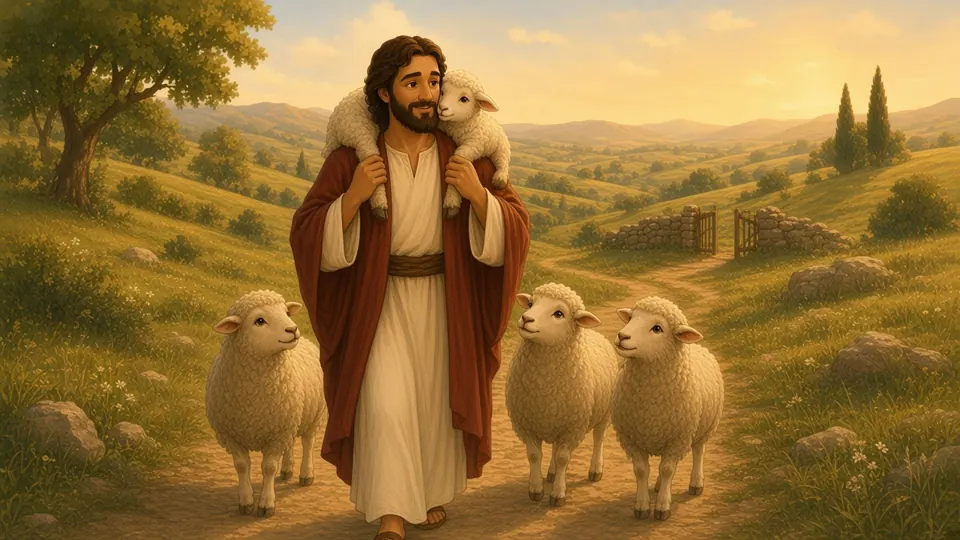
Jesus the Good Shepherd
John 10:1–18
John 10 follows directly on the healing of the man born blind, whom the religious leaders had driven out (Jn 9). The contrast is intentional. Some leaders have failed the flock. Jesus presents himself as the shepherd Israel has been waiting for.
The background is Ezekiel 34, where God condemns shepherds who feed themselves instead of the sheep and promises that he himself will search for his flock and care for it. When Jesus says he is the Good Shepherd, he is claiming to do what God promised to do.
He begins with a figure of speech. The legitimate shepherd enters the fold by the gate; thieves climb in another way. The sheep recognize their shepherd's voice; he calls them individually and leads them out. Then he applies it in two ways. He is the gate: through him alone the sheep find safety, freedom and pasture, and he came to give life in its fullness. And he is the Good Shepherd, the Greek word meaning noble or beautiful as much as good. Unlike the hired hand, who flees when the wolf comes, he lays down his life for the sheep.
Three features stand out.
Intimate knowledge. Jesus knows his own and they know him, as the Father and the Son know each other. Faith is not first a set of rules; it is a relationship of mutual knowledge.
Unity. He has other sheep beyond this fold and will gather them into one flock under one shepherd. In context this concerns the Gentiles, and the Church reads it as Christ's will for the unity of all his followers. It is a call to unity in Christ, not a claim that all paths are the same.
Freedom. No one takes his life; he lays it down and takes it up again, by the Father's command. The cross is not something that happened to Jesus by accident. It is a gift.
The Catechism draws on this image to describe the Church: she is the sheepfold whose sole and necessary gate is Christ, and the flock led by Christ himself, the Good Shepherd and chief shepherd (CCC 754). The bishops, with the Pope, govern in the name of Christ (CCC 895), with the Good Shepherd as their model (CCC 896), and the ordained priest acts in the person of Christ the Head, shepherd of his flock (CCC 1548). After the Resurrection Jesus gave Peter a special charge to feed his sheep (Jn 21:15–17), and the Church sees the Pope continuing Peter's office as shepherd of the whole flock (CCC 553, 881). Every pastoral office is measured by this chapter.
Talk about it
- How does Ezekiel 34 change the way you hear Jesus' claim to be the Good Shepherd?
- What is the difference between a shepherd and a hired hand in your relationships and responsibilities?
- How should Christians understand the other sheep and one flock without saying all paths are the same?
- What does it mean to you that Jesus laid down his life freely?
Key verse: Jn 10:11–15. Look it up in your Bible.
Illustrations created with Grok (AI) and reviewed by our team. Narration voice: Kokoro TTS (AI), Apache 2.0.