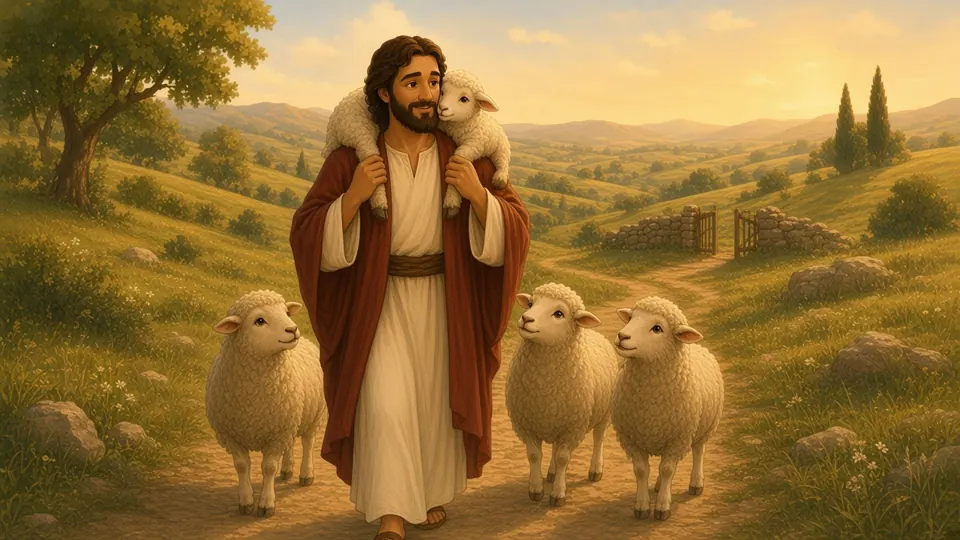
Jesus the Good Shepherd
John 10:1–18
Shepherding was everyday work in first-century Israel, and the Scriptures often called God the shepherd of his people (Ps 23; Ezek 34). So when Jesus spoke about shepherds, his listeners knew he was making a big claim.
He began with a scene everyone recognized. Several flocks would share one walled sheepfold at night, with a gatekeeper on duty. Anyone who climbed over the wall instead of coming through the gate was up to no good. But the true shepherd comes through the gate. The gatekeeper lets him in, he calls his own sheep by name and leads them out, and they follow because they know his voice.
When his hearers missed the point, Jesus spoke more plainly. First, he called himself the gate. Whoever enters through him will be saved and will go in and out and find pasture. Thieves come to steal and destroy, but he came so that the sheep may have life in abundance.
Then he called himself the Good Shepherd, the one who lays down his life for the sheep. A hired hand is in it only for the pay. When he sees the wolf coming, he runs away, and the flock scatters. The Good Shepherd stays, because the sheep are his own.
Jesus added that his knowledge of his sheep is like the knowledge between him and the Father: personal and deep. He also has other sheep not of this fold, and he must bring them too. They will hear his voice, and there will be one flock, one shepherd.
Finally, he said something astonishing. No one takes his life from him. He lays it down freely, and he has power to take it up again. That is exactly what happened on Good Friday and Easter.
The Church sees herself in this passage. She is the sheepfold whose one gate is Christ, and the flock whose shepherd is Christ himself (CCC 754). He cares for his people through the pastors he gives the Church, the Pope and the bishops with their priests, who are meant to serve the way he did (CCC 896, 1548).
One more thing: this is not the same as Jesus' story of the lost sheep, which is in Luke 15 and Matthew 18. Both show his love, but they are different teachings.
Talk about it
- Why would Jesus' listeners connect a good shepherd with God himself?
- What does it mean that Jesus lays down his life freely?
- What makes a pastor a good shepherd today?
- Where in your week can you get quiet enough to hear Jesus' voice?
Key verse: Jn 10:11. Look it up in your Bible.
Illustrations created with Grok (AI) and reviewed by our team. Narration voice: Kokoro TTS (AI), Apache 2.0.