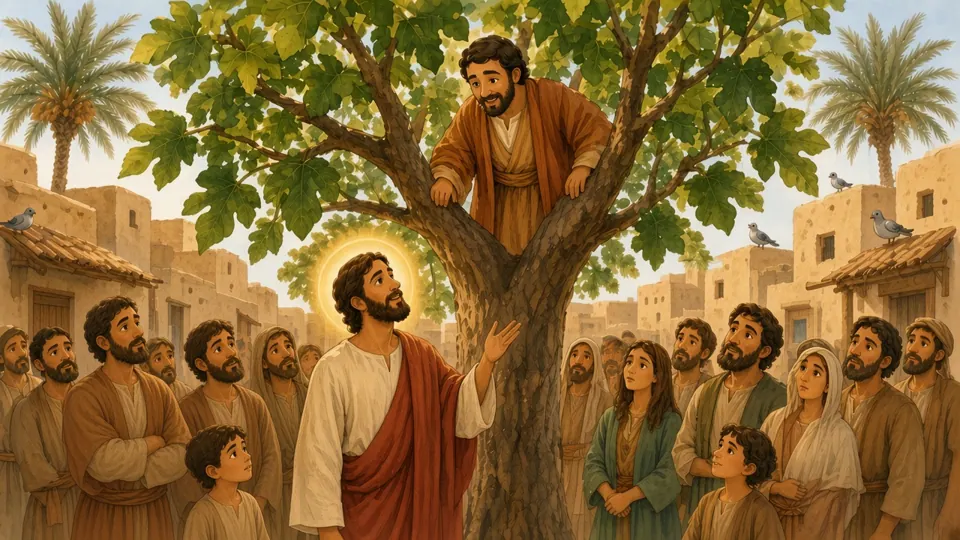
Zacchaeus Climbs a Tree
Luke 19:1–10
Zacchaeus is usually a children's story, complete with a song. Read as an adult, it is a story about money, reputation and what real change costs.
He had done well. Chief tax collector in Jericho, one of the richest towns in the region, he had the house, the staff and the income. He also had the reputation: collaborator, cheat, sinner. People like that often stop expecting anything from God. Yet something in him was still curious, and curiosity was enough to get him up a tree, in public, in front of the people who despised him (Lk 19:1–4).
Jesus' response is the heart of the story. He stops, looks up and calls him by name, and he doesn't start with a lecture. He invites himself to dinner. The crowd, as crowds do, complains that he has chosen a sinner's house. Jesus has chosen exactly that, on purpose: as the Son of Man he came to go after people who have lost their way and bring them home (Lk 19:10).
What happens next is what conversion looks like in adult life. Zacchaeus stands up at his own table and puts his money where his repentance is: half of his goods to the poor, and fourfold repayment to anyone he has cheated. That isn't a vague resolution to be a better person. It is a plan, with numbers.
Most of us aren't tax collectors. But many of us know the quieter versions: padding expense reports, cutting corners on taxes, paying a contractor late because we can, work done poorly, taking credit that belongs to someone else. The Catechism names these plainly as sins against justice (CCC 2409), and it teaches that forgiveness doesn't cancel the duty to make restitution where we can (CCC 2412). Confession restores us to God; restitution restores what we took from others.
Zacchaeus' story is also about reputation. Some people come back to the Church carrying a past everyone knows about. Others carry one no one knows. Either way, the crowd's verdict isn't the last word. Jesus' is, and he says that God's salvation has arrived in that house today.
St. Matthew, the apostle and evangelist, was also a tax collector when Jesus called him from his booth (Mt 9:9). He left the table and followed, and he went on to write a Gospel. God doesn't only forgive a compromised career. He can turn it into a vocation.
A real-life step: ask honestly whether there is anything in your work or finances that Zacchaeus would want to make right, and make one concrete repair this month. And notice whom you have written off. Jesus may be stopping under their tree.
Talk about it
- What in your work or finances would Zacchaeus want to make right? What is one concrete step?
- Why do you think Jesus invited himself to dinner rather than starting with a lecture?
- How does the crowd's verdict on someone compare with Jesus' verdict?
- Catholic connection: read CCC 2409 and 2412 on justice and restitution.
Key verse: Lk 19:8. Look it up in your Bible.
Illustrations created with Grok (AI) and reviewed by our team. Narration voice: Kokoro TTS (AI), Apache 2.0.