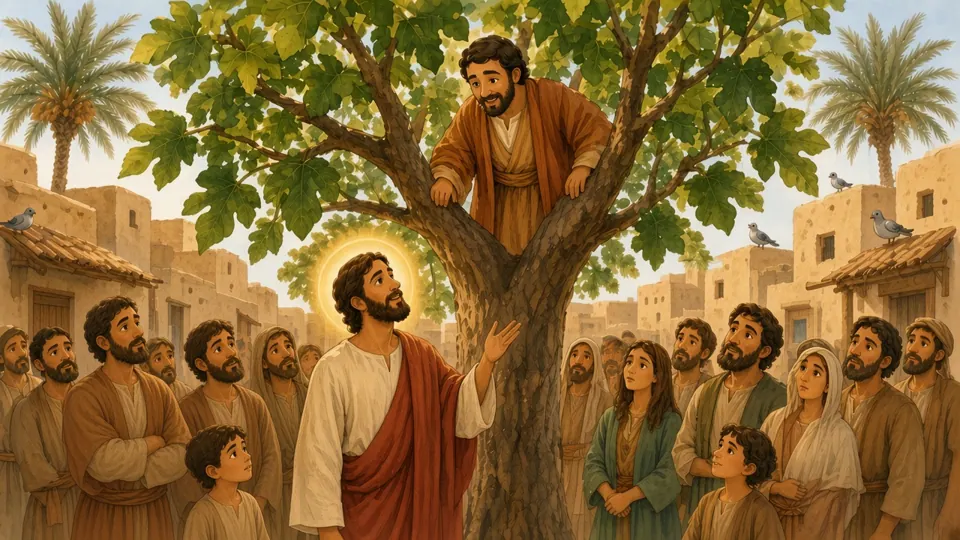
Zacchaeus Climbs a Tree
Luke 19:1–10
The story of Zacchaeus (Lk 19:1–10) is short, funny and famous, and it comes at a turning point. It is the last encounter Luke records before Jesus enters Jerusalem to die.
The story: Jesus is passing through Jericho. Zacchaeus, a wealthy chief tax collector, wants to see him but is too short to see over the crowd, so he climbs a sycamore fig. Jesus stops, calls him by name, and invites himself to his house that day. Zacchaeus comes down rejoicing; the crowd complains that Jesus is a sinner's guest. Zacchaeus pledges half his goods to the poor and fourfold repayment to anyone he has defrauded. Jesus says salvation has arrived in that household, for Zacchaeus too is a son of Abraham, and that his mission as the Son of Man is to go after people who have lost their way and bring them home.
Some context. Tax collectors in Roman Palestine bid for the right to collect tolls and kept whatever they took above the contract. Many grew rich by overcharging, and they were seen as collaborators. Luke doesn't make Zacchaeus a villain or a hero; he makes him a man who is curious enough to look foolish.
Three things worth thinking through.
Mercy before conversion. Jesus names Zacchaeus and enters his house before Zacchaeus has promised anything. That is the pattern of the Gospel: Jesus invites sinners to his table (CCC 545). It doesn't mean sin doesn't matter. It means God's love is not a reward for getting better; it is what makes getting better possible.
Repentance that costs something. Zacchaeus doesn't only feel sorry; he repairs the damage. The Church teaches the same. Forgiveness in Confession takes away the sin, but justice still asks us to repair the harm where we can, for example by returning what was stolen or restoring someone's good name (CCC 1459, 2412). The Law usually asked for what was taken plus a fifth (Num 5:6–7), and fourfold only from someone who stole a sheep (Ex 22:1; Ex 21:37 in Hebrew numbering and the NABRE). Zacchaeus volunteers the stricter penalty. It is gratitude, not calculation.
Is wealth itself the problem? Not here. One chapter earlier, a rich ruler walks away from Jesus sad, unable to let go (Lk 18:18–23), and Jesus says that what is impossible for people is possible for God (Lk 18:27). Zacchaeus is the possible. He keeps half of what he has, but money no longer has him. Love for the poor becomes part of his faith (CCC 2443).
And the crowd? Luke says everyone grumbled. It is easy to cast ourselves as Zacchaeus. It is just as true that we are sometimes the crowd, keeping someone's worst reputation alive and annoyed when God is kinder to them than we are.
Think of the person at school whom everyone has written off. Jesus would stop under that person's tree.
Talk about it
- Why does it matter that Jesus calls Zacchaeus before Zacchaeus promises to change?
- What does the Church mean by repairing harm after Confession (CCC 1459)?
- How is Zacchaeus different from the rich ruler in Luke 18:18–23?
- When have you been part of 'the crowd' toward someone?
Key verse: Lk 19:8–10. Look it up in your Bible.
Illustrations created with Grok (AI) and reviewed by our team. Narration voice: Kokoro TTS (AI), Apache 2.0.