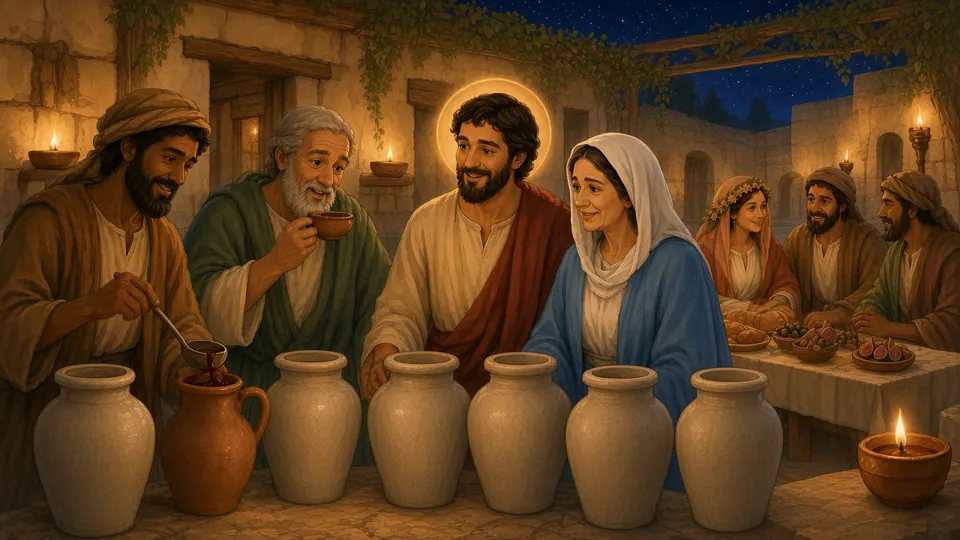
The Wedding at Cana
John 2:1–11
Cana is easy to read as a charming party story, and it is that. But John, who writes with great care, opens Jesus' public signs not with a healing or a confrontation, but with joy at a wedding, and with Mary.
Context: Galilean weddings could last up to a week; the groom's family was expected to provide, and failing the guests was a lasting embarrassment. The six stone jars, with room for twenty or thirty gallons apiece, were for Jewish ritual washing; stone vessels were preferred because they were thought not to become ritually unclean. The prophets pictured the age of the Messiah as a banquet overflowing with fine wine (Is 25:6; Amos 9:13–14), and God's covenant with Israel as a marriage (Hos 2:19–20; Is 62:5).
The story: the wine runs out. Mary tells Jesus. He responds, addressing her as 'Woman', that his hour is still to come. She tells the servants to do what he says. At his word they fill the jars with water; drawn out, it is wine, finer than what came before, and the steward, who doesn't know its source, compliments the groom for saving the best until last. John calls it the first of Jesus' signs: his glory shone out, and his disciples' faith began.
The Church's reading: Christ's presence at Cana affirms the goodness of marriage and announces that marriage will be an effective sign of his presence, a sacrament (CCC 1613). Christian marriage signifies the union of Christ and the Church (CCC 1617; 1661; Eph 5:31–32), and Christ is the source of the grace that sustains it (CCC 1642). At Cana, Mary's faith and intercession are on display (CCC 2618), and her words to the servants sum up the purpose of all true devotion to her: it leads to her Son (cf. CCC 971). The Catechism also reads the sign as announcing the hour of Jesus' glorification and the wedding feast of the kingdom, where the faithful drink the new wine that has become his Blood (CCC 1335). The Church remembers Cana together with the Epiphany and the Baptism of the Lord as moments when Christ was made known (CCC 528).
For adult life:
If you are married, invite Jesus into the ordinary pressures of your home: money, schedules, tiredness, the wine running out. The sacrament is not only the wedding day; it is grace for every day after.
If you are preparing for marriage, single, or discerning another vocation, Cana says that Jesus cares about real human joys, not only spiritual ones.
For everyone: Mary's prayer is short and trusting. She names the need and leaves the solution to her Son. Many adult prayers are long lists of instructions for God. Cana invites something simpler: tell him, then do what he says.
Sts. Louis and Zélie Martin, the parents of St. Thérèse of Lisieux, were canonized together in 2015, the first married couple canonized in the same ceremony. Their marriage held the deaths of four of their nine children, money worries and Zélie's cancer, and they carried it with faithful Mass-going, prayer and work side by side.
A real-life step: if you're married, pray together this week, even one Hail Mary at night. If not, pray for a married couple you know, by name.
Talk about it
- Where is the wine running out in your life or your home right now?
- What could you learn from the way Mary brings the need to Jesus without telling him what to do?
- How does the sacrament of Marriage depend on grace, not only on effort (CCC 1642)?
- Catholic connection: read CCC 1613. What does Jesus' presence at Cana say about marriage?
Key verse: Jn 2:5. Look it up in your Bible.
Illustrations created with Grok (AI) and reviewed by our team. Narration voice: Kokoro TTS (AI), Apache 2.0.