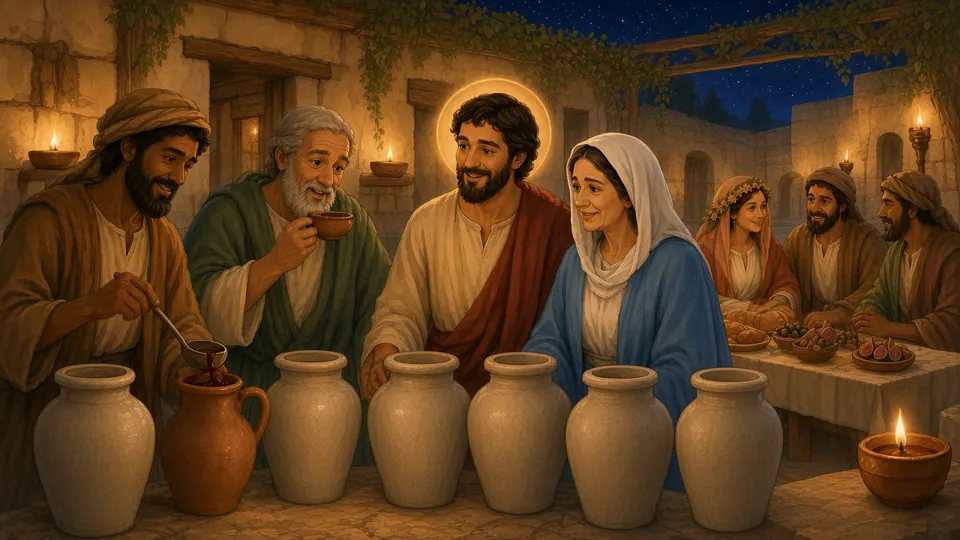
The Wedding at Cana
John 2:1–11
John's Gospel doesn't call Jesus' miracles 'miracles'. It calls them signs, because each one points beyond itself to who Jesus is. The first sign happens not in the Temple or before a crowd, but at a village wedding (Jn 2:1–11).
The setting: Cana was a small town in Galilee, a few miles from Nazareth. Weddings there were community events that could go on for a week, and hospitality was a matter of honor. Running out of wine would shame the groom's family in front of the whole village.
Mary, the mother of Jesus, is a guest, and Jesus and his disciples have been invited too. When the wine gives out, Mary brings the problem to Jesus in a few plain words: the wine is gone. Notice that she doesn't tell him what to do. She simply hands him the need.
Jesus' reply can sound abrupt in English. He addresses her as 'Woman' and tells her that this is not yet a matter for them, because his hour has not arrived. 'Woman' was not rude in Jesus' language and culture; it was a dignified way to address someone. And in John's Gospel, 'the hour' means the hour of Jesus' death and glory on the Cross, where he will again call his mother 'Woman' (Jn 19:26).
Mary isn't discouraged. She tells the servants to do what Jesus says. These are her last recorded words in the Gospels, and they are good advice for every Christian.
Nearby are six big stone jars that hold water for Jewish purification washings; each one takes twenty or thirty gallons. Jesus tells the servants to fill them with water, and they fill them to the top. Then he has them carry some to the head steward, who tastes it and finds it is wine. Not knowing where it came from, the steward teases the groom for doing things backward: he has saved his finest wine until the end of the party.
Think about the amount: perhaps 120 to 180 gallons of excellent wine, far more than the party needed. In the Old Testament, overflowing wine was a sign of the joy God would bring in the days of the Messiah (Amos 9:13–14; Is 25:6). Jesus is showing that this time has begun.
John says that through this sign Jesus' glory shone out, and it was the beginning of his disciples' faith (Jn 2:11).
The Church sees several things here. Jesus blesses marriage by his presence at a wedding (CCC 1613). Mary intercedes, bringing our needs to her Son and pointing us to him (CCC 2618). And water turned into wine points ahead to the Eucharist, where wine becomes Christ's Blood (CCC 1335).
Talk about it
- Why was running out of wine such a problem at a wedding in Cana?
- What do Mary's words to the servants teach us about following Jesus?
- Why do you think Jesus made so much wine, and such good wine?
Key verse: Jn 2:5. Look it up in your Bible.
Illustrations created with Grok (AI) and reviewed by our team. Narration voice: Kokoro TTS (AI), Apache 2.0.