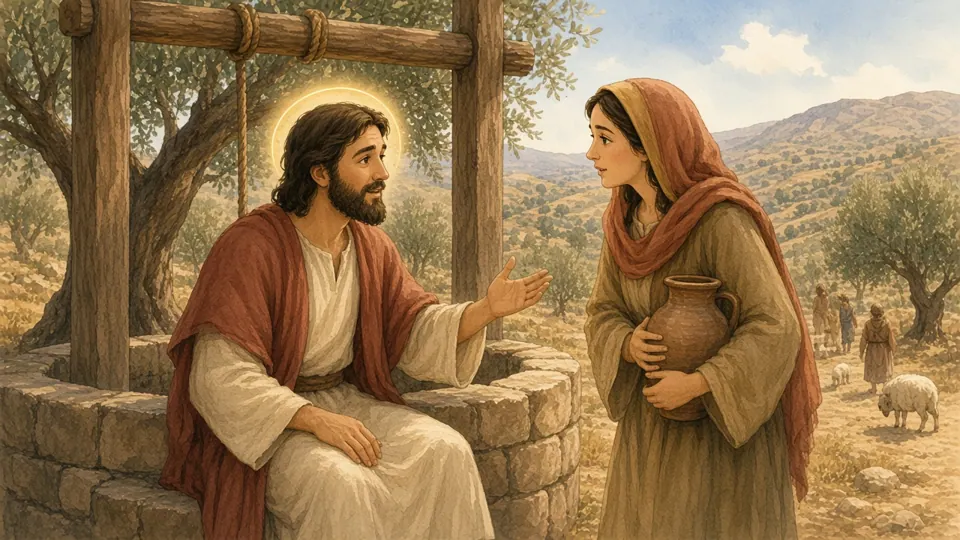
The Woman at the Well
John 4:1–42
She comes to the well at noon. In a village, women usually drew water together, in the cool of the morning or evening. John doesn't say why this woman comes alone in the heat, and we shouldn't assume too much, but many readers have heard loneliness in that detail (Jn 4:6–7).
Jesus is there first, tired and thirsty, and he asks her for help. It is a small, human request, and it crosses every line that was supposed to keep them apart: Jew and Samaritan, man and woman, a rabbi and someone with a past. The God who could have started with a demand starts with a need.
The conversation moves quickly from water to thirst. Jesus offers living water, which keeps springing up inside a person and carries them into eternal life. Every adult knows the other kind of water, the kind that never quite satisfies: success, approval, relationships, a better job, a better house, the next thing. She has tried more than most. When Jesus gently names her history, five husbands and a man who is not her husband, he isn't scoring a point. He is touching the thirst underneath it.
What she does next is very human: she changes the subject to religion. Which mountain is right, yours or ours? Many of us still do this, arguing about the Church to avoid letting Christ near us. Jesus takes her question seriously, and then brings it back to God himself, who wants worship offered in Spirit and truth (CCC 1179). And when she mentions the Messiah, he tells her plainly that it is him.
She leaves her water jar. The thing she came for no longer matters as much as the person she has found. And she goes straight back to the people she may have been avoiding, with a strange and honest invitation: come and meet a man who knew everything about me. Her testimony isn't polished. It is simply true, and the town comes.
Here is the real-life connection. Many people carry a story they would rather no one knew: a divorce, a relationship, an addiction, a long time away from the Church. Jesus doesn't ask us to clean that up before we come to the well. He asks us to let him tell us the truth about it, and then to stay. Confession is where that happens most directly: being fully known and still welcomed (CCC 1468).
Eastern Christian tradition remembers her as St. Photini, 'the enlightened one', and honors her as a missionary and martyr. Whatever one makes of the later legends, the Gospel gives her a title of its own: the first person in John to bring a whole town to Jesus.
This week, notice your thirsts. Name one honestly in prayer. And if someone in your life carries a story everyone knows, make sure they find a welcome at your well.
Talk about it
- What are you trying to satisfy your thirst with, besides God?
- Do you ever change the subject to religion to avoid letting Christ close? How?
- Is there a part of your story you have kept from God? What might it mean to let him name it, and stay?
- Catholic connection: read CCC 2560–2561 on God thirsting for us.
Key verse: Jn 4:29. Look it up in your Bible.
Illustrations created with Grok (AI) and reviewed by our team. Narration voice: Kokoro TTS (AI), Apache 2.0.