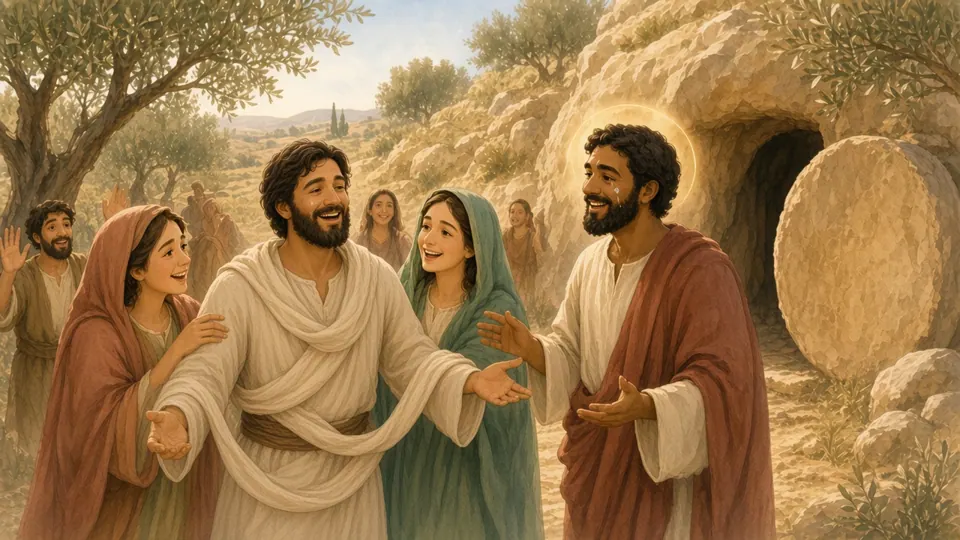
Jesus Raises Lazarus
John 11:1–44
Anyone who has buried someone they love will recognize the question both sisters bring to Jesus: where were you? Each tells him, in almost the same words, that her brother would be alive if he had come (Jn 11:21, 32).
John doesn't hide the tension. He tells us that Jesus loved Martha, her sister and Lazarus, and in the next breath that he stayed away two more days (Jn 11:5–6). Love and delay sit side by side. That is often how faith feels in adult life: a diagnosis, a miscarriage, a marriage that doesn't heal, a prayer that seems to hit the ceiling.
What Jesus does when he arrives is instructive. With Martha, who comes out to him with her questions, he talks about the deepest things: he is the Resurrection and the Life, and death does not have the last word over anyone who believes in him. With Mary, who comes in tears, he doesn't argue. He asks where they have laid her brother, and he weeps. The Lord meets each grieving person differently. One needs a truth to hold on to; the other needs someone to cry with. Most of us need both, at different times.
Then he acts. He asks for the stone to be rolled away, though Martha protests that after four days there will be a smell. Faith often means letting God near the part of our life we have sealed up because it is too painful, or too shameful, to open. Jesus thanks the Father aloud, then calls Lazarus by name. The man comes out still bound, and Jesus hands the community a task: take off the wrappings and free him. St. Augustine read that detail as a picture of the Church's work. Christ gives the dead their life back, and the Church helps loosen what still binds them (Tractates on John 49.24).
Lazarus would die again. His return was a sign, not the goal. The goal is the life Christ himself entered at Easter, a new life that death cannot touch (CCC 646), and the resurrection the Church hopes for all who die in him (CCC 989).
The people of Bethany did something simple that matters: they came. They sat with the sisters for days. Comforting the sorrowful and burying the dead are works of mercy (CCC 2447), and they are mostly a matter of showing up, bringing food, and staying when there is nothing to say.
Since 2021 the Church keeps a single memorial on 29 July for Sts. Martha, Mary and Lazarus together: a family of friends of Jesus who knew grief, waiting and joy in one house.
A real-life step: think of one person you know who is grieving, recently or long ago. Reach out this week, without trying to fix anything. And when your own prayer seems to meet silence, pray Martha's words in your own way: even now, Lord, I believe.
Talk about it
- Where in your life does God's timing feel like absence right now?
- Do you tend to meet grief like Martha (with questions) or like Mary (with tears)? What do you need from Jesus?
- Who near you is grieving, and how could you show up for them this week (CCC 2447)?
- Catholic connection: read CCC 989. What does the Church hope for those who die in Christ?
Key verse: Jn 11:35. Look it up in your Bible.
Illustrations created with Grok (AI) and reviewed by our team. Narration voice: Kokoro TTS (AI), Apache 2.0.