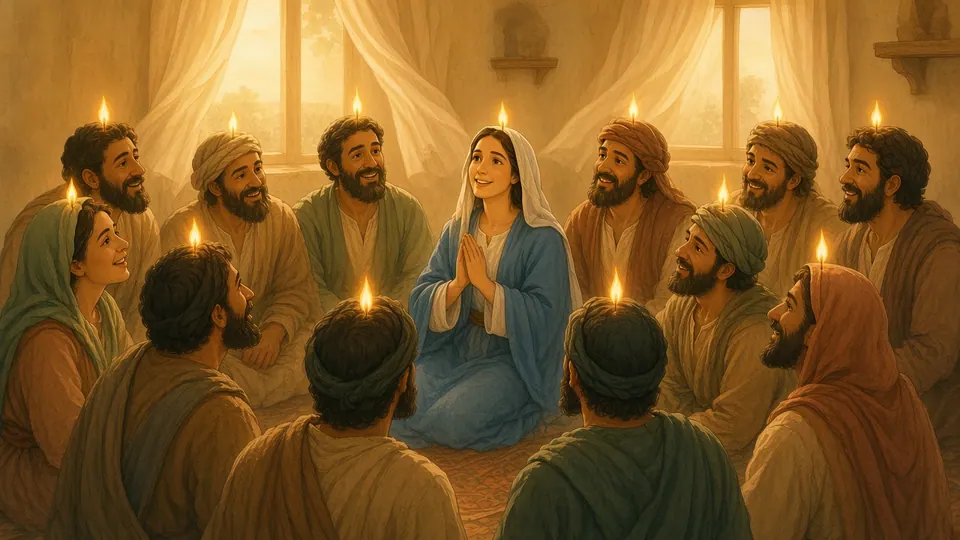
The Holy Spirit Comes at Pentecost
Acts 2:1–41
Fifty days after Easter, a small, frightened group in an upstairs room becomes a public movement. Acts 2 is the moment the Church goes outside.
The setting: Jesus told the apostles to wait in Jerusalem for the promised Spirit (Acts 1:4–8). About a hundred and twenty believers prayed together, Mary among them (1:14). Pentecost, the Feast of Weeks, came fifty days after Passover and filled Jerusalem with Jewish pilgrims from across the known world.
The story: as the believers are gathered, a sound like a storm wind fills the house, and what look like flames rest on each of them. Filled with the Holy Spirit, they begin speaking in languages they never learned. Pilgrims from Parthia to Rome hear Galileans praising God in the languages they grew up speaking. Some are amazed; others mock them as drunk. Peter stands up and gives the first Christian sermon. It is nine in the morning; this is Joel's prophecy of the Spirit poured out on all. Jesus, whom God showed through signs, was handed over and put to death, but God raised him, as David's psalms foretold, and the apostles are witnesses. Exalted at the Father's right hand, he has poured out the Spirit. The crowd, deeply shaken, asks what to do. Peter calls them to turn back to God and be baptized in Jesus' name, so that their sins are forgiven and they too receive the Spirit. About three thousand are baptized.
What the Church sees here: Pentecost completes Easter. The risen Christ pours out the Spirit, now known as a divine person, so that Father, Son and Spirit stand fully revealed (CCC 731–732). The Church appears in public for the first time, and mission belongs to who she is (CCC 767; 1076). From that day the Church has baptized (CCC 1226), and Confirmation carries the grace of Pentecost forward to each believer (CCC 1287–1288; 1302). The fire stands for the Spirit's power to transform (CCC 696), and the wind recalls that the Hebrew word for spirit also means breath and wind (CCC 691).
Honest questions:
Is speaking in tongues still a thing? In Acts 2 the gift is real human languages that the hearers understand. The Spirit still gives many gifts, ordinary and extraordinary, always for building up the Church (CCC 2003).
Did Peter blame the Jewish people? Peter, a Jew, was speaking to fellow Jews in Jerusalem, calling them to conversion, and three thousand of them believed. The Church teaches that responsibility for Jesus' death cannot be laid on the Jews as a whole, and that the apostles' calls to repentance do not change that (CCC 597).
Why does it matter that everyone heard their own language? Christian tradition has long read Pentecost as the undoing of Babel (Gen 11:1–9), where pride scattered humanity into many languages (CCC 57); St. Gregory of Nazianzus, for one, contrasts the two in his sermon on Pentecost (Oration 41.16). At Pentecost the Spirit gathers people without erasing their languages. That reading comes from Christian tradition, not from the text of Acts itself.
The Spirit who turned Peter from a denier into a preacher is the same Spirit given in Confirmation. The gift is not only for saints in stories.
Talk about it
- What changed in Peter between Good Friday and Pentecost, and what caused it?
- Why do you think the Spirit came with signs people could hear and see?
- Pentecost gathered people from many languages into one Church. What divides people your age, and how could the Spirit bring them together?
- Catholic connection: read CCC 1302. What does Confirmation have to do with Pentecost?
Key verse: Acts 2:38. Look it up in your Bible.
Illustrations created with Grok (AI) and reviewed by our team. Narration voice: Kokoro TTS (AI), Apache 2.0.