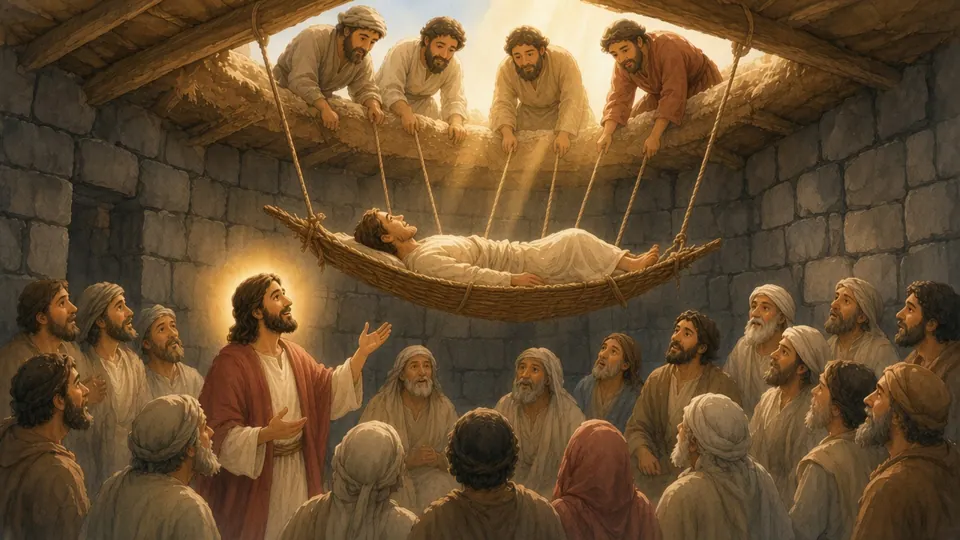
Through the Roof to Jesus
Mark 2:1–12
This story has two miracles, and Mark makes it clear which one matters more. The visible one, a paralyzed man walking, is there to prove the invisible one: his sins are forgiven.
Context: Capernaum was a lakeside fishing town and Jesus' base in Galilee. Excavations there have uncovered small basalt houses grouped around courtyards, and one house, honored by early Christians, is traditionally identified as Peter's; archaeology supports the tradition but can't prove it. Roofs were wooden beams laid with branches and packed clay, reached by an outside stair. Scribes were trained experts in the Law. In Jewish belief then, as in Christian belief now, only God can forgive sins against God; priests offered the Temple sacrifices for sin, and prophets announced God's mercy, but no one forgave sins on his own authority.
The story: so many people crowd the house that the doorway is blocked. Four men carrying a paralyzed friend dig through the roof and lower him in front of Jesus. Seeing their faith, Jesus speaks to the man tenderly, as to a son, and forgives his sins. Some scribes present silently charge him with blasphemy. Jesus reads their thoughts and challenges them: anyone can claim to forgive, since no one sees it, but a command to a paralyzed man can be tested on the spot. To prove that he, the Son of Man, can forgive sins here and now, by God's own authority, he commands the man to get up and go home with his mat. He does, and the crowd praises God.
The Church's reading: Jesus' forgiving of sins scandalized his opponents because it was a claim to act as God (CCC 589), and only God forgives sins (CCC 1441). Christ, the physician of souls and bodies, who forgave the paralyzed man and healed him, willed that his Church continue this work in the sacraments of healing, Penance and the Anointing of the Sick (CCC 1421). He entrusted the ministry of reconciliation to his apostles, and bishops and priests exercise it in his name (CCC 1442; 1461).
For adult life:
Be one of the four. Every adult knows someone who can't, or won't, get to Jesus on their own: a friend in addiction, a sibling who has left the Church, a colleague in despair. The friends didn't fix him; they carried him and made a way. Prayer for others, practical help and persistence are how many people reach Christ (CCC 2635).
Let yourself be carried. Some seasons of adult life leave us paralyzed by grief, shame, depression or exhaustion. Accepting the help of others, and the prayers of the Church, is not weakness.
Go after the deeper healing. Many adults bring God their visible problems and keep their sins hidden. Jesus begins with forgiveness. The Sacrament of Reconciliation is where that word is still spoken aloud, with Christ's own authority.
St. John Vianney, the patron saint of parish priests, spent long hours, often most of the day, hearing confessions in the small French village of Ars, and people traveled from all over France to be reconciled with God.
A real-life step: go to Confession this month. And choose one person to carry in prayer, by name, every day this week.
Talk about it
- Who in your life needs you to be one of the four friends?
- When have you needed to let others carry you?
- What keeps adults from bringing their sins, not just their problems, to Jesus?
- Catholic connection: read CCC 1421 and 1442. How does Jesus' healing continue in the Church today?
Key verse: Mk 2:10. Look it up in your Bible.
Illustrations created with Grok (AI) and reviewed by our team. Narration voice: Kokoro TTS (AI), Apache 2.0.