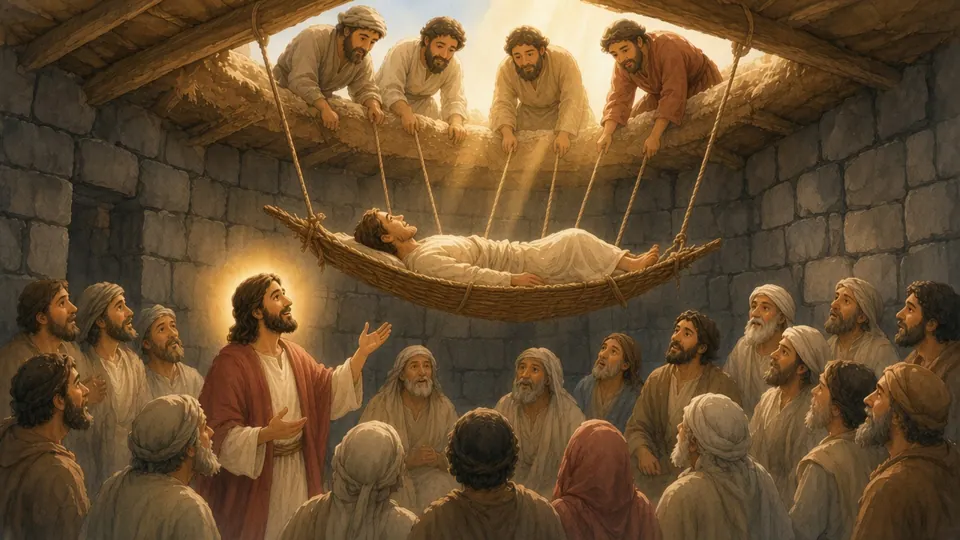
Through the Roof to Jesus
Mark 2:1–12
Mark 2:1–12 is the first time in Mark's Gospel that Jesus faces open opposition, and the issue is not healing. It's forgiveness.
The story: Jesus is back in Capernaum, at home, and so many people gather that even the doorway is blocked. As he's preaching, four men bring a paralyzed man on a mat. Blocked by the crowd, they climb up, open the roof above Jesus and lower the mat down. Seeing their faith, Jesus speaks to the man tenderly, as to a son, and forgives his sins. Some scribes sit there thinking it's blasphemy, since forgiving sins belongs to God alone. Jesus, knowing their thoughts, challenges them: forgiveness can't be seen, but a healing can. Then, to prove that he, the Son of Man, can forgive sins here and now, by God's own authority, he tells the man to stand up and walk home, carrying his mat. He does, with everyone watching, and the whole crowd breaks into praise of God, astonished by what they have seen.
What the Church sees here:
Only God forgives sins, and Jesus does. The scribes' theology is correct; their conclusion is the problem. Jesus' forgiving of sins scandalized them precisely because it meant he was acting as God (CCC 589; 1441). Jesus doesn't back down. He backs up his claim with a visible sign. This is one of the clearest passages in the Gospels showing Jesus acting as God.
The Son of Man. Jesus' favorite title for himself recalls Daniel's vision of a heavenly figure who receives everlasting dominion from God (Dan 7:13–14). At his trial, Jesus will use that same title, and the high priest will call it blasphemy (Mk 14:61–64).
The sacraments of healing. The Catechism sees in this scene the roots of the Church's two sacraments of healing: Christ, the physician of our souls and bodies, who forgave the paralyzed man and restored his health, wants his Church to continue his work of healing and salvation (CCC 1421). That happens in Reconciliation and in the Anointing of the Sick. Christ gave the apostles the power to forgive sins in his name (Jn 20:22–23), and bishops and priests exercise it today (CCC 1442; 1461).
Faith on someone else's behalf. Jesus responds to the faith of the friends. That's a model for praying for others (CCC 2634–2635).
Honest questions:
Was the man paralyzed because he sinned? The text doesn't say so, and Jesus elsewhere rejects that idea (Jn 9:2–3). Scripture connects suffering in general with a world wounded by sin, but no one's illness should be read as personal punishment. Jesus came as the physician of the whole person, soul and body (CCC 1503). Jesus addresses the deeper need first.
Why confess to a priest instead of just to God? It is God who forgives. But Jesus chose to give that ministry to his apostles, so that forgiveness would be spoken aloud, by a human voice, as it was to this man. Hearing it said with Christ's authority is a gift.
Isn't it arrogant for Jesus to claim this? It would be, if he weren't who he says he is. That's the choice the passage puts in front of every reader.
A step this week: think of one friend who is struggling, and carry them to Jesus by praying for them by name every day.
Talk about it
- The scribes were right that only God forgives sins. What did that mean about Jesus?
- What does the faith of the four friends teach about praying for others?
- How would you explain to a friend why Catholics confess to a priest (CCC 1441–1442)?
- Catholic connection: read CCC 1421. Which two sacraments continue Jesus' healing?
Key verse: Mk 2:10. Look it up in your Bible.
Illustrations created with Grok (AI) and reviewed by our team. Narration voice: Kokoro TTS (AI), Apache 2.0.