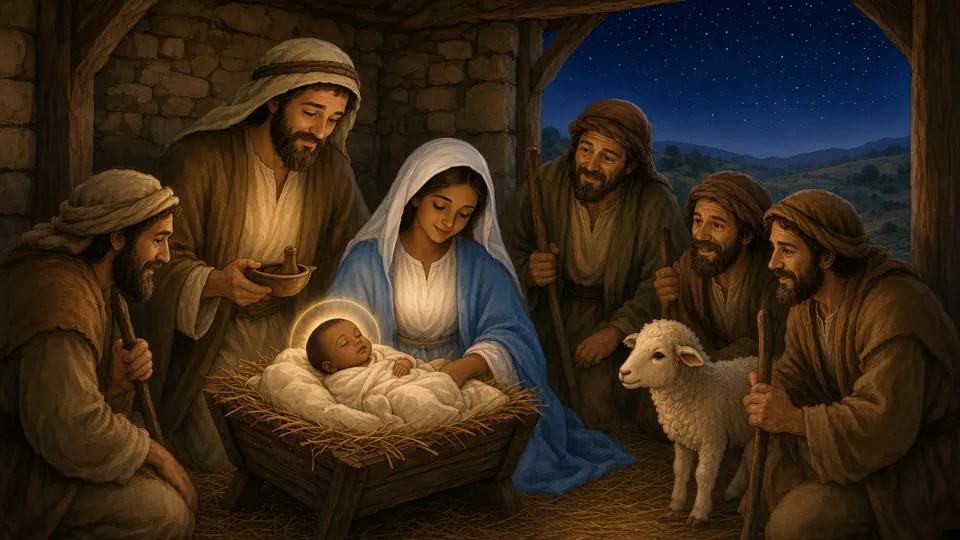
Jesus Is Born
Luke 2:1–20
Luke places the birth of Jesus under the shadow of an empire. Caesar Augustus was hailed across the Mediterranean as a savior and a bringer of peace. His decree for a registration, most likely tied to taxation, reached even a small-town couple in Galilee. Joseph, a descendant of David, has to travel to Bethlehem with Mary, who is near the end of her pregnancy. It's an inconvenient, costly journey ordered by a foreign power. Yet through it God keeps his word: the promised son of David is born in David's town (2 Sam 7:12–16; Mic 5:2).
The birth itself is told in a single breath. Mary delivers her firstborn son, wraps him in strips of cloth as every careful mother did, and settles him in a feeding trough because the guest space is taken. The word Luke uses can mean a guest room in a family home as well as an inn. Either way, the point stands: the first bed of the Son of God belongs to animals.
The first to hear the news are shepherds on the night shift: necessary workers, but low on the social ladder. An angel stands before them, God's glory lights up the hillside, and they are afraid. The message is news to gladden the whole nation: a Savior is born today, Messiah and Lord. The sign is almost comically ordinary, a swaddled baby in a manger. Then the sky opens with a vast host of angels praising God and announcing God's peace to the people he loves.
The shepherds go at once, find everything as promised, and become the first to spread the news. Mary absorbs it all and keeps turning the events over, searching their meaning. The shepherds return to work, still praising God.
The Church reads this scene as the mystery of the Incarnation made visible: the eternal Son, without ceasing to be God, becomes truly man (CCC 464, 470). The Catechism adds that to share in this mystery we must become humble and childlike, like the child in the manger (CCC 526). Christians have long noticed that Bethlehem means house of bread, and that the newborn is placed in a feeding trough. Read through Tradition, it is a hint of the One who would give himself as the Bread of Life in the Eucharist (Jn 6:35).
For adult life:
God enters ordinary, inconvenient circumstances. If your season is shaped by forces you didn't choose, such as a job move, money pressure or a crowded home, this is exactly the kind of setting God chose for himself.
Humility is not low self-esteem. It is making room. The shepherds had nothing to offer but showing up.
Mary models a faith that reflects instead of only reacting. Many adults rush past what God is doing because they never stop to look.
In 1223, St. Francis of Assisi arranged a living nativity scene in a cave at Greccio so people could see how poor Christ became for us.
A real-life step: before your next Mass, think of receiving Communion as kneeling at the manger. Then look for one person this week who, like the shepherds, is easy to overlook, and make room for them.
Talk about it
- What does it mean to you that God entered the world under an empire, in poverty, on the move?
- The shepherds were the first witnesses. Who in your workplace, parish or family is easy to overlook?
- Mary reflected before reacting. Where do you need to slow down and notice what God is doing?
- Catholic connection: CCC 526 says we share in this mystery by becoming humble and childlike. How could that change the way you approach Christmas this year?
Key verse: Lk 2:11. Look it up in your Bible.
Illustrations created with Grok (AI) and reviewed by our team. Narration voice: Kokoro TTS (AI), Apache 2.0.