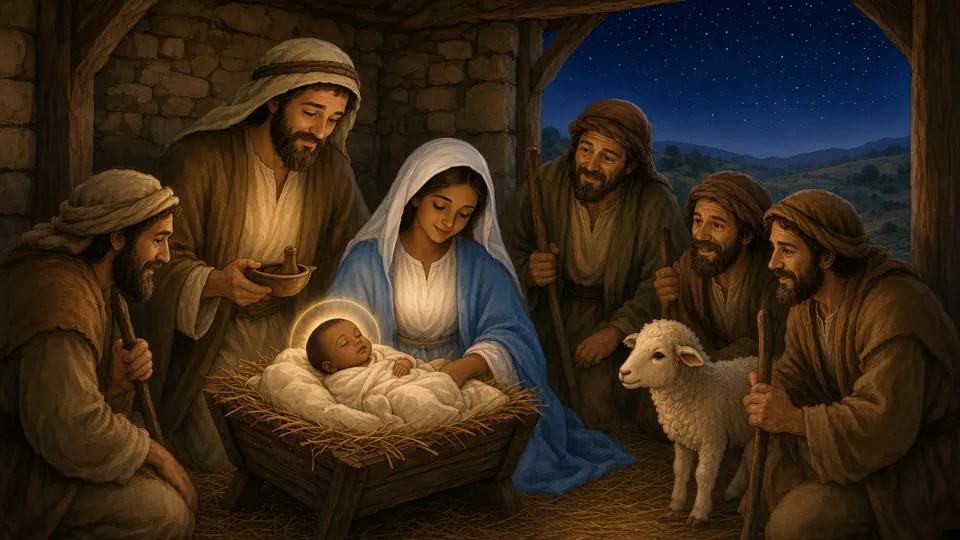
Jesus Is Born
Luke 2:1–20
Luke tells the birth of Jesus like a historian setting a scene. Augustus is emperor. A registration is under way while Quirinius governs Syria. Historians still debate exactly how Luke's census fits with other records. That's an honest open question, but it doesn't change Luke's point: God works inside real history, with real rulers and real places.
Joseph, from the family line of David, goes from Nazareth to Bethlehem to register, taking Mary, his betrothed, who is pregnant. While they are in Bethlehem, she gives birth to her firstborn son, wraps him in cloths, and puts him in a manger because no guest room is available. That's the whole birth scene in Luke: two verses, no drama, no special effects. The Son of God enters the world quietly and poor.
Meanwhile, out in the fields, shepherds are working the night shift with their sheep. An angel appears, God's glory surrounds them, and they are terrified. The angel's message is packed with titles that mattered enormously to Jewish listeners: the newborn is Savior, Messiah (the anointed king God had promised) and Lord, a title used for God himself. Then a vast army of angels fills the sky, giving glory to God and announcing God's peace for the people he loves.
The shepherds go at once, find the family just as described, and tell everyone what they heard. People are amazed. Mary takes it all in and keeps reflecting on its meaning. The shepherds head back, praising God.
Why does this matter? Because the Church's faith is that this baby is not a good man who later became special. He is the eternal Son of God, who became fully human while remaining fully God (CCC 464). God didn't just send a message about love. He came in person, small enough to be held. That is also why the Church calls Mary the Mother of God: the child she bore is God the Son (CCC 495).
Honest answers to common questions:
Was Jesus born on December 25? The Gospels don't give a date. December 25 is the day the Church has long celebrated his birth. What matters is that it really happened.
Isn't the manger scene just a sweet story? Luke's details are deliberately uncomfortable: an occupied land, a journey ordered by a foreign ruler, a birth among animals, and outsiders as the first witnesses. God chose poverty and humility on purpose.
Talk about it
- Luke names an emperor and a governor. Why does it matter that Jesus' birth is set in real history?
- The angel calls the baby Savior, Messiah and Lord. What does each title claim about him?
- How would you answer a friend who says the Christmas story is a nice myth?
- Catholic connection: read CCC 464. Why does it matter that Jesus is fully God and fully man?
Key verse: Lk 2:11. Look it up in your Bible.
Illustrations created with Grok (AI) and reviewed by our team. Narration voice: Kokoro TTS (AI), Apache 2.0.