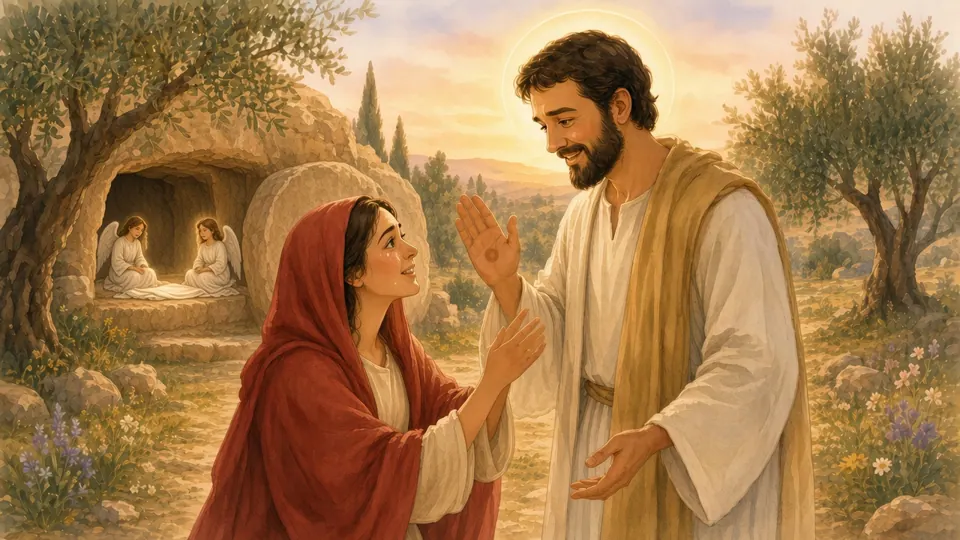
Mary Magdalene Meets the Risen Jesus
John 20:1–18
John 20 is the Gospel of Easter Sunday morning (verses 1–9), and verses 1–2 and 11–18 are read on her feast, 22 July. Its central figure is Mary Magdalene.
The story: before dawn on the first day of the week, Mary finds the stone moved from the tomb and runs to tell Peter and the beloved disciple that the Lord's body has been taken. They run to the tomb, see the burial cloths, and the beloved disciple believes; then they return home. Mary stays, weeping. Two angels in white ask why she weeps. She turns and sees Jesus, mistakes him for the gardener, and asks where he has laid the body. He calls her by name; she recognizes him and calls him Rabbouni. He tells her not to cling to him, for he has not yet ascended, and sends her to tell his brothers. She announces to the disciples that she has seen the Lord.
Who was she? Scripture tells us what we know. She was from Magdala in Galilee; Jesus freed her from seven demons; she traveled with him and helped support his ministry (Lk 8:2–3). She stood by the cross (Jn 19:25), saw where he was buried, and was first at the tomb.
You may hear that she was the sinful woman of Luke 7, but Scripture never says so; the idea grew from a homily Pope St. Gregory the Great preached around 591. In 2016 the Church raised her 22 July memorial to a feast, and she is honored as 'apostle to the apostles'.
Three things worth noticing.
Recognition by name. Mary doesn't know Jesus by sight but by his voice speaking her name, just as the shepherd calls his sheep by name (Jn 10:3). Faith is often like that: less a proof than a personal call.
A real, transformed body. The risen Jesus is not a ghost; he has a real body, but one that is glorified, no longer limited in the same way (CCC 645–646). That is why she can mistake him, and why he can speak of his Ascension.
The first witness. In a culture where women's testimony was often given less weight, the Gospels agree that women were the first witnesses to the empty tomb, and John and Matthew that they were the first to meet the risen Lord (Mt 28:9–10). The Catechism notes that the women were the first messengers of the Resurrection, even to the apostles (CCC 641).
The Resurrection is not a lovely idea. It is a real event in history with real witnesses (CCC 639, 643), and the first of them was a grieving woman who stayed.
Talk about it
- What does Scripture actually tell us about Mary Magdalene, and what is later legend?
- Why is it significant that Mary recognized Jesus when he said her name?
- What does the Catechism mean by the risen body being glorified (CCC 645)?
- Why is it important that women were the first witnesses of the Resurrection (CCC 641)?
Key verse: Jn 20:17–18. Look it up in your Bible.
Illustrations created with Grok (AI) and reviewed by our team. Narration voice: Kokoro TTS (AI), Apache 2.0.