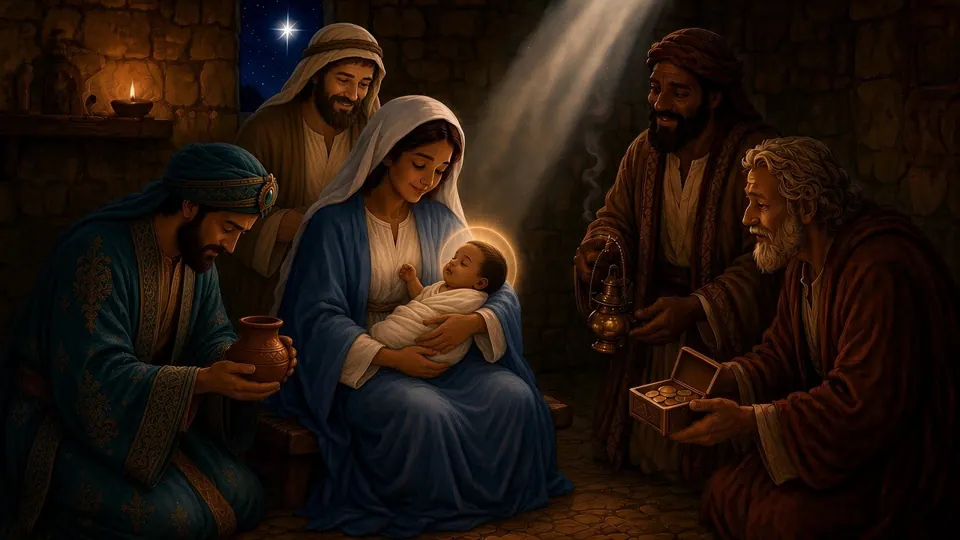
The Wise Men Visit Jesus
Matthew 2:1–12
Matthew's infancy story has a quiet drama to it. Jesus is born in Bethlehem in the days of Herod the Great, a capable and ruthless king. Into his capital walk magi from the East, astrologer-scholars of the Persian or Babylonian world, asking a dangerous question: where is the one born King of the Jews? They have seen his star rising and have come to worship.
Herod is troubled, and all Jerusalem with him. He summons the chief priests and scribes, who know the answer from Scripture: the Messiah will come from Bethlehem, the town of David, as Micah foretold (Mic 5:2). Notice the irony Matthew sets up. The experts know where to go but do not go. The foreigners, with only a star and a partial knowledge, travel the whole way.
Herod questions the magi secretly about the star's timing and sends them on, claiming he also wants to worship. Matthew does not need to say more; the reader can tell his interest is not devotion.
The star leads them on and comes to rest over the place. Matthew's Greek overflows: they rejoiced with a very great joy. In the house they find the child with Mary his mother, fall down and worship him, and open their treasures. Then a dream warns them away from Herod, and they return by a different route.
The Church reads this scene as the Epiphany, the manifestation of Christ. The Catechism explains that the magi represent the pagan nations, and that their coming means the nations can now receive the Good News of salvation through the Incarnation. To come to Jesus and worship him as Son of God and Savior of the world, they must turn to the Jews and receive the promise contained in the Old Testament (CCC 528). Their path to Christ runs through Israel's Scriptures.
Honest answers to common questions:
Was it a real star? Matthew presents it as a sign God gave. People have proposed conjunctions of planets or a comet; the text does not settle it, and the meaning does not depend on it.
Were there three kings? Scripture says magi and three gifts. Their number, royal status and names belong to later Christian tradition. Early Christian writers also saw meaning in the gifts: gold for a king, incense for God, myrrh for one who would die. That reading comes from early Church Fathers such as St. Irenaeus, not from Matthew himself.
Why go home another way? Meeting Christ changes the road you travel afterward.
Talk about it
- Why might Matthew contrast the scribes, who knew the Scriptures, with the magi, who made the journey?
- CCC 528 says the magi had to turn to the Jews and their Scriptures. Why does that matter?
- What gifts of your time and talent could you bring to Christ?
- How do you tell the difference between what Scripture says and what tradition adds?
Key verse: Mt 2:10–11. Look it up in your Bible.
Illustrations created with Grok (AI) and reviewed by our team. Narration voice: Kokoro TTS (AI), Apache 2.0.