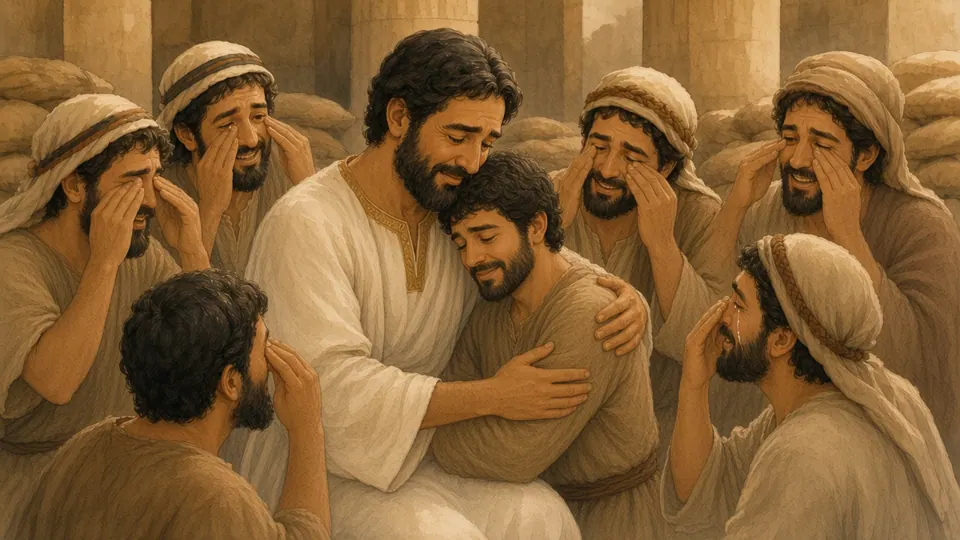
Joseph Forgives His Brothers
Genesis 37:1–36; 45:1–15
Joseph's story is about a family that nearly destroys itself, and a God who quietly works through all of it.
The family is a mess from the start. Jacob has sons by four different women and openly favors Joseph, giving him an ornate robe. Joseph, seventeen, reports on his brothers and shares dreams in which they bow to him. The brothers' jealousy becomes hatred.
Sent to find them in the pastures, Joseph walks into a trap. They plan to kill him. Reuben persuades them to throw him into a dry cistern, hoping to rescue him later. Then Judah suggests a more profitable option: sell him to traders bound for Egypt. They get twenty pieces of silver, stain his robe with goat's blood, and let their father believe he is dead. Jacob mourns, and nothing can console him.
The middle chapters (Gen 39–44) are a long reversal. Joseph is a slave, then falsely accused and imprisoned. Through it all Genesis repeats that God stayed with him. He interprets Pharaoh's dreams, is made governor of Egypt, and stores grain against famine. His brothers come to buy food and bow down before him, not recognizing him. He tests them, and finds that Judah is now willing to give himself up to save Benjamin.
In Gen 45 Joseph can't hold back any longer. He clears the room and weeps loudly. He tells them who he is. They are speechless with fear. He draws them close and tells them not to tear themselves apart with regret: God sent him ahead to save lives. He sends for his father, promises to provide for everyone, embraces Benjamin, and kisses each brother. Then, finally, they talk.
What the Church sees here: The Catechism uses Joseph's words to explain providence. God can bring good even out of evil done by people, without ever causing or approving the evil (CCC 312; Gen 45:8; 50:20). The greatest example is the Cross: the worst sin ever committed became the source of salvation (CCC 312). Joseph's forgiveness also shows what Jesus asks of us in the Our Father (CCC 2842–2845).
Honest questions:
Does forgiving mean pretending it didn't happen? No. Joseph names what they did. He tests whether they have changed before he reveals himself. Forgiveness is a choice to release revenge, and it can come with honesty and wise limits. Reconciliation, trust rebuilt on both sides, may take longer.
Did God make the brothers sin so things would work out? No. They chose freely and are responsible. God's providence works through and around human choices, even evil ones, without causing them (CCC 311–312).
Why does Joseph test them? Not for revenge. He needs to know whether the brothers who sold one favored son would abandon another. Judah's offer shows real repentance.
The Church Fathers saw Joseph as a figure of Christ: the beloved son, rejected and sold by his brothers, raised from a pit to a throne, and feeding the world. (Tradition, not an explicit verse.)
Talk about it
- How did favoritism and jealousy damage this family? Where do you see that happen today?
- What is the difference between forgiving someone and trusting them again?
- How can God bring good out of something evil without approving the evil?
- Catholic connection: read CCC 312. How does the Cross show the same pattern as Joseph's story?
Key verse: Gen 45:5. Look it up in your Bible.
Illustrations created with Grok (AI) and reviewed by our team. Narration voice: Kokoro TTS (AI), Apache 2.0.