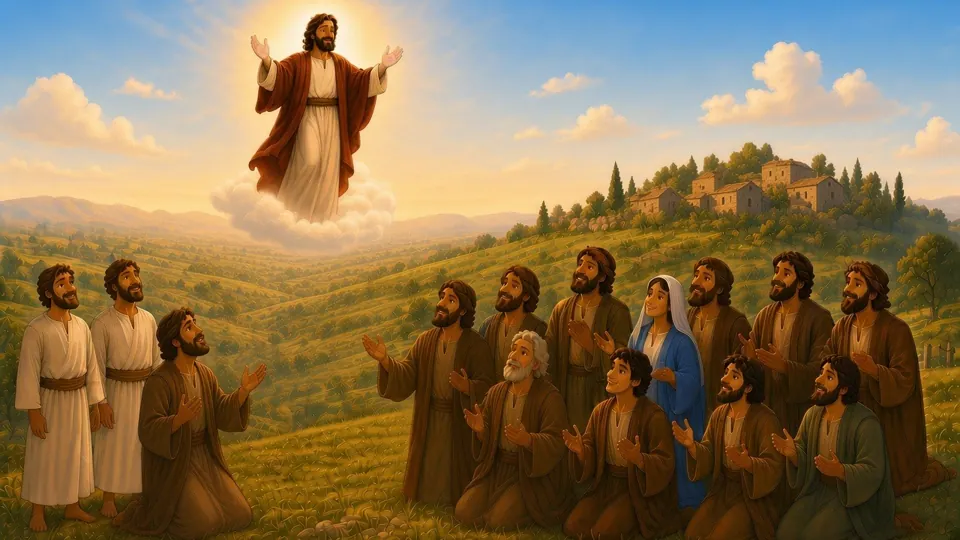
Jesus Goes Up to Heaven
Acts 1:6–11
Luke narrates the Ascension twice, once as the closing scene of his Gospel (Lk 24:50–53) and again as the opening of Acts (Acts 1:6–11). The doubling is deliberate. In the Gospel it is the culmination of Jesus' earthly mission; in Acts it is the foundation of the Church's. Luke's differing details, a compressed Easter-day frame in the Gospel and forty days of appearances in Acts, show a theologian arranging material for distinct purposes, not an author confused about his own story.
The Acts account turns on a correction. The apostles ask whether this is the time to restore the kingdom to Israel. Jesus does not deny Israel's hope, but he removes the timetable from their hands and gives them a mission instead: power from the Holy Spirit and witness from Jerusalem to the end of the earth. The cloud that receives him recalls the cloud of glory at Sinai and in the Temple, and the cloud of the Son of Man in Daniel 7. The two men in white, like those at the empty tomb, interpret the event: the same Jesus will return in the same manner.
Luke's Gospel adds the liturgical response. With hands raised, Jesus blesses them, as the high priest Simon blessed the people in Sirach 50. They prostrate themselves in worship, return to Jerusalem with great joy and remain continually in the Temple blessing God. The disciples' first act after the Ascension is not mourning but praise.
The Church's teaching:
The humanity of Christ enters glory. The Ascension is the irreversible entry of Jesus' humanity into divine glory (CCC 659). The forty days had a veiled glory; the Ascension marks his exaltation at the Father's right hand (CCC 660).
The way is opened. Only the one who came from the Father can return to the Father, and he does so as our head, so that we, his members, might follow (CCC 661).
Priestly intercession. Lifted up, Christ draws all to himself and, as high priest of the good things to come, always lives to make intercession for us (CCC 662).
A present reign. Christ's Lordship over the cosmos and history is already real, and the Church is the seed and beginning of his Kingdom on earth (CCC 669). He goes ahead of us, our Head, so that we may hope to be with him for ever (CCC 666).
Heaven as God's mode of being. The heaven into which Christ ascends is not a region above the clouds but God's majesty and presence (CCC 2794).
For adult life:
The temptation to stand gazing upward is real: piety that waits for God to act while neglecting the mission he gave. The angels send the apostles back to Jerusalem, to community, prayer and work.
Absence can be a form of gift. Christ goes so that the Spirit may come, and he becomes present in every tabernacle and every gathering in his name.
Praise is the right response to what God has done, even when the future is unclear. The disciples did not know what came next; they blessed God anyway.
A real-life step: pray the Glorious Mysteries of the Rosary this week, lingering on the second, and ask for the grace to be a witness where you live and work.
Talk about it
- How do the two Lucan accounts of the Ascension serve different purposes?
- In what part of your life are you tempted to stand gazing upward rather than taking up the mission?
- How does Christ's priestly intercession (CCC 662) shape your prayer?
- What would praising God with an uncertain future look like in your life right now?
Key verse: Lk 24:50–53. Look it up in your Bible.
Illustrations created with Grok (AI) and reviewed by our team. Narration voice: Kokoro TTS (AI), Apache 2.0.