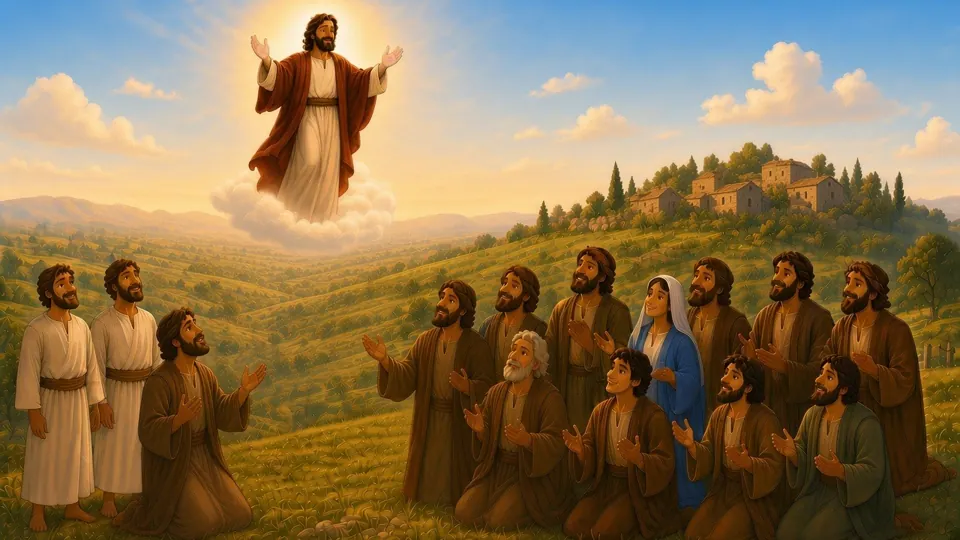
Jesus Goes Up to Heaven
Acts 1:6–11
The Ascension is told twice by the same author. Luke closes his Gospel with it and opens Acts with it, so that it marks both an ending and a beginning. The two accounts differ in detail, and it's worth reading both honestly. The Gospel's version is compressed and places it near Bethany, while Acts speaks of forty days of appearances and sets the scene on the Mount of Olives, which overlooks Bethany. Luke is not contradicting himself; he is telling the same event for two different purposes.
In Acts 1:6–11 the apostles still hope for a political restoration of Israel. Jesus redirects them. The timing belongs to the Father. Their task is witness, empowered by the Spirit, moving outward from Jerusalem through Judea and Samaria to the ends of the earth. Then he is lifted up, and a cloud, the biblical sign of God's glory, receives him. Two men in white rebuke their sky-gazing and promise his return in the same way.
The Gospel ending (Lk 24:50–53) supplies the response. Jesus lifts his hands and blesses them, a priestly gesture. They worship him, return to Jerusalem with great joy and spend their time in the Temple blessing God. The Gospel that began in the Temple with Zechariah ends in the Temple with praise.
What the Church teaches:
Christ's risen body entered divine glory. The Ascension marks the definitive entrance of Jesus' humanity into God's heavenly domain, from which he will come again (CCC 665). The Catechism distinguishes the glory of the risen Christ during the forty days, when it was still veiled, from his exaltation at the Ascension (CCC 660).
Only the one who came down can go up. Left to our own powers we have no access to the Father's house; Christ opens the way (CCC 661).
He is our high priest. Lifted up, he intercedes for us and draws all to himself (CCC 662).
He reigns now. Seated at the Father's right hand, Christ is Lord of the cosmos and of history, and his reign is already present in the Church (CCC 668–669). He goes ahead of us, our Head, so that we may hope to be with him for ever (CCC 666).
Heaven is not a place in the sky. The phrase who art in heaven refers not to a place but to God's majesty and his presence in the hearts of the just (CCC 2794).
So the Ascension is not absence. It is a new mode of presence: through the Spirit, the sacraments and the Church, the ascended Christ is closer than when he walked one road in Galilee.
Talk about it
- How do the two accounts of the Ascension in Luke and Acts complement each other?
- Why might the angels rebuke the apostles for gazing at the sky?
- How is the Ascension a new kind of presence rather than an absence?
- What does it look like for you to be a witness in your own world: school, team, online?
Key verse: Acts 1:8. Look it up in your Bible.
Illustrations created with Grok (AI) and reviewed by our team. Narration voice: Kokoro TTS (AI), Apache 2.0.