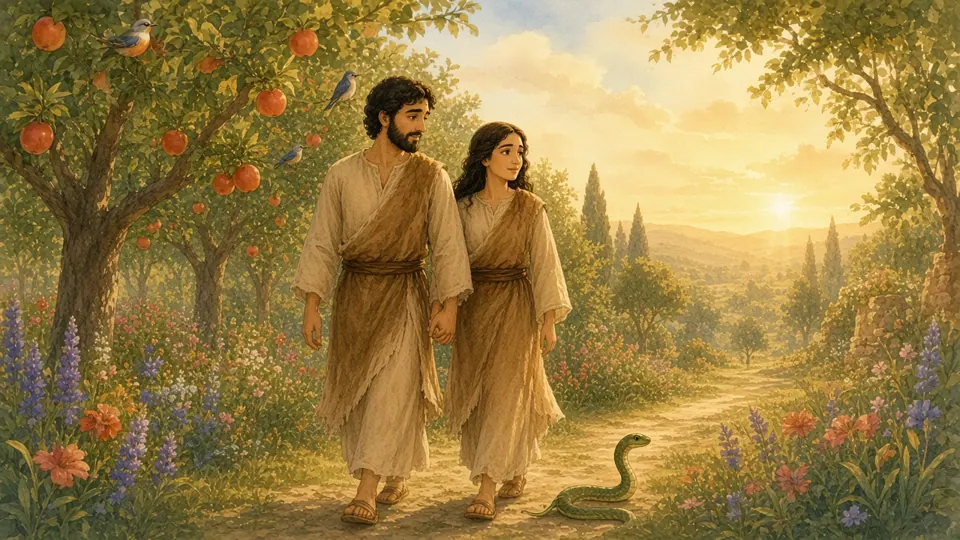
The First Sin and God's Promise
Genesis 3:1–24
Genesis 3 is short, but it answers a huge question: if God made everything good, why is the world so broken?
God gives Adam and Eve a whole garden and one limit: don't eat from the tree of the knowledge of good and evil. The limit is not a trap. It is a reminder that they are creatures, free and loved, but not God. Living well means trusting the One who made them.
The serpent, the craftiest creature, goes after exactly that trust. It exaggerates God's command, then flatly contradicts it: they won't die. God is just keeping them from becoming like him. The temptation is not mainly about fruit. It's about deciding for themselves what is good and evil, without God.
Eve sees that the fruit looks tasty and lovely, and that it seems to promise insight. She eats; Adam, standing with her, eats too. Their eyes do change, but what they see is their own nakedness. Shame replaces innocence. They make coverings from fig leaves and hide when they hear God in the garden.
God's first word after the sin is a question, asking the man where he is. He gives them room to come clean. They don't. Adam blames Eve (and the God who gave her), Eve blames the serpent. Every broken relationship we know shows up here: with God, with each other, with creation, and inside ourselves.
The consequences are serious: pain in childbirth, struggle between husband and wife, exhausting work, and death. They leave Eden, and the tree of life is guarded by cherubim.
Yet two acts of mercy frame the exit. God tells the serpent that it and the woman will be enemies, and so will her children and its brood, and that her offspring will crush its head while being struck at the heel. And God makes them clothes from animal skins himself.
What the Church teaches: Genesis 3 uses figurative language, but it tells of a real event at the start of human history: our first parents freely disobeyed God (CCC 390). At root, the first sin was a failure to trust God and a misuse of freedom (CCC 397). The serpent is understood as Satan, a fallen angel (CCC 391–395). We inherit a human nature wounded by that sin, which the Church calls original sin. It is not a personal fault we committed, but a lack of the holiness God intended, with a pull toward sin (CCC 404–405). Baptism takes away original sin, though the struggle remains (CCC 405).
Honest questions:
Is this story meant to be literal history? The Church says the language is figurative, but the event is real (CCC 390). It isn't a science report, and it isn't just a myth either. Faith and science study the same world and can't truly contradict each other (CCC 159).
Why would God allow evil at all? Love has to be free, and freedom can be misused (CCC 311). God doesn't stop there: he permits evil only to draw a greater good from it, and he answered the first sin by sending a Redeemer (CCC 412).
Isn't it unfair that we suffer for their sin? We don't carry their guilt. We are born into the family they started, which lost the gift of original holiness. Christ, the new Adam, opens a better inheritance (Rom 5:18–19).
Talk about it
- The serpent's real temptation is to decide good and evil without God. Where do you see that temptation today?
- Why do you think Adam and Eve blamed someone else instead of admitting what they did?
- What two acts of mercy does God show before Adam and Eve leave the garden?
- Catholic connection: read CCC 410–411. Why do Christians call Gen 3:15 the first Gospel?
Key verse: Gen 3:15. Look it up in your Bible.
Illustrations created with Grok (AI) and reviewed by our team. Narration voice: Kokoro TTS (AI), Apache 2.0.