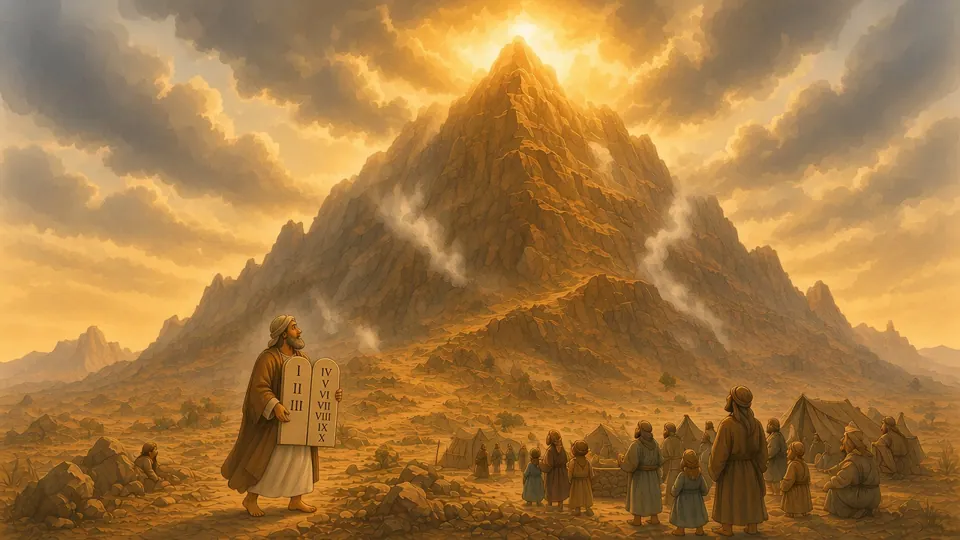
God Gives the Ten Commandments
Exodus 19:1–20:21
Exodus 19 opens with a date: in the third month after leaving Egypt, Israel arrives at Sinai. The setting matters. These are former slaves, newly free, camped in the wilderness. Before anything is asked of them, God speaks of what he has already done: he bore them up as on eagles' wings and brought them to himself. Then comes the offer. If they keep his covenant, they will be his own possession among all peoples, a kingdom of priests and a holy nation. The people say yes.
Three days of preparation follow: washing, abstaining, a boundary around the mountain. Then God comes down in fire, cloud and the blast of a trumpet, and the mountain shakes. Exodus is not describing a scary God. It is describing a holy one, so far beyond us that his nearness is overwhelming.
Then God gives the Ten Commandments (Scripture calls them the 'ten words,' meaning ten sayings). He begins by telling them who he is: the Lord their God, who brought them out of slavery in Egypt (Ex 20:2). Everything else flows from that. The Catechism says the commandments receive their full meaning inside the covenant (CCC 2061–2062): they are Israel's response of love to the God who saved them.
Catholics follow St. Augustine's numbering. The first commandment includes the ban on idols, and coveting is split in two. So: one God only; his name is holy; keep holy the Lord's Day; honor father and mother; do not kill; do not commit adultery; do not steal; do not bear false witness; do not covet your neighbor's spouse; do not covet your neighbor's goods. The first three concern love of God, the other seven love of neighbor (CCC 2067).
Afterward the people keep back from the mountain and ask Moses to be their go-between. Moses tells them not to fear: God has come so that reverence for him will keep them from sin.
Why should a teenager care about a list carved in stone? Because the commandments are not arbitrary. The Church teaches that they spell out the natural law, what any honest conscience can recognize (CCC 2070), and that they are fundamentally unchangeable and bind everyone, always (CCC 2072). They protect the things that make life human: God's place in our lives, family, life itself, faithful love, property, truth and a clean heart.
Jesus confirmed the commandments and revealed their depth. When a young man asked him what to do to have eternal life, Jesus answered: keep the commandments (Mt 19:16–19). Then he invited him further, to follow him.
Talk about it
- Why do the commandments begin with God's act of rescue rather than with a rule?
- How does the Catholic numbering differ from the one some other Christians use, and does the difference change the content?
- The Church says the commandments express the natural law. What does that mean?
- Which commandment do you think our culture struggles with most? Why?
Key verse: Ex 20:2–3. Look it up in your Bible.
Illustrations created with Grok (AI) and reviewed by our team. Narration voice: Kokoro TTS (AI), Apache 2.0.