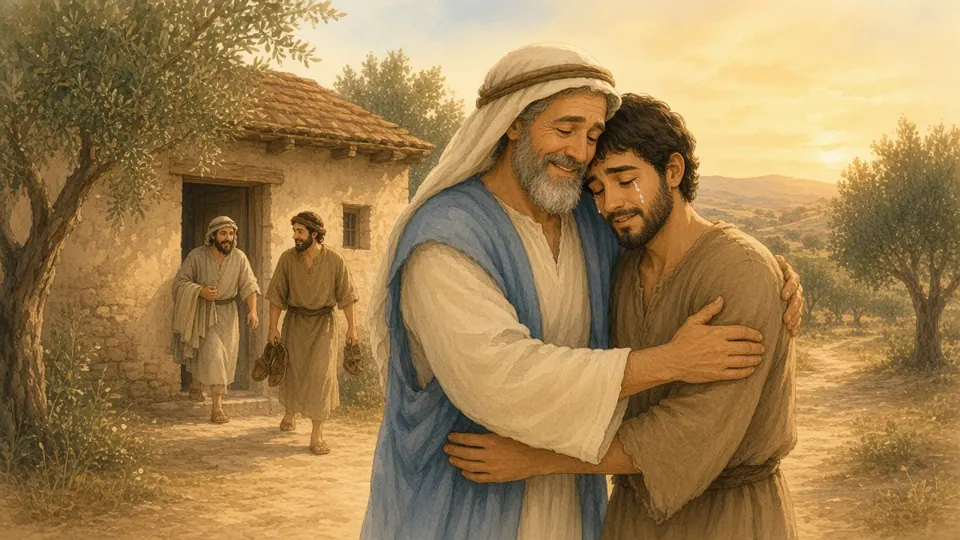
The Son Who Came Home
Luke 15:11–32
Jesus tells this parable to a mixed crowd: tax collectors and people with bad reputations who are drawn to him, and some Pharisees and scribes who object that he welcomes sinners and eats with them (Lk 15:1–2). It's the third of three lost-and-found stories, and it's the one where the lost one can choose.
The younger son asks for his inheritance early, which amounts to cashing out of the relationship while his father is still alive. The father gives it to him. The son leaves, wastes everything in a faraway land on reckless living, and has nothing left when famine hits. He ends up feeding pigs, ritually unclean animals for a Jew, and wishing he could eat their feed. Nobody helps him.
His turning point isn't very noble at first. He's hungry, and he knows his father's hired workers eat well. He drafts an apology: he has sinned against God and against his father, he no longer deserves to be treated as a son, and maybe he could be hired as a worker. Then he heads home.
Now the story turns to the father. He spots his son far down the road, is overwhelmed with love, and runs to embrace and kiss him before the apology is finished. He cuts the speech short and restores everything: the finest robe, a ring, sandals, a feast. A son who thought he could at best be a servant is welcomed as a son. The father sums it up: losing him was like a death, and having him back is like new life.
The older son, coming in from the fields, hears the celebration and refuses to join. His complaint is real: years of faithful work, never a party, and now this. The father goes out to him as well, reminds him that he has always been with him and that everything the father has is his, and pleads with him to share the joy. The story ends without telling us his answer.
What the Church sees here: the Catechism uses this parable to describe conversion. It traces the son's misused freedom, the misery that follows, his honest look at himself, his decision to confess, the journey back, and the father's generous welcome. The robe, ring and feast stand for the new life, pure and full of dignity, that God gives to those who return (CCC 1439). Grace comes first: the father loves his son before, during and after the apology. We can't earn that love, but we can accept it, and real repentance changes how we live.
Honest questions:
Isn't this unfair to the older brother? From a scorecard point of view, yes. But the father isn't keeping score. The older brother never lost his place. What he lacks is his father's heart. Jesus invites the grumblers, and every so-called good person, to celebrate when someone comes back.
If God forgives anything, why try to be good? Because sin isn't a harmless option God puts up with. It nearly destroyed the younger son. And the older brother shows that you can stay home and still be far from the father. The goal is love, not just rule-keeping.
Why confess to a priest instead of only to God? Catholics believe Jesus gave his apostles the power to forgive sins in his name (Jn 20:22–23). In Confession you hear out loud that you are forgiven: the father's embrace, made audible (CCC 1441–1442, 1461).
Talk about it
- Trace the younger son's journey. Where does real change begin: when he is hungry, or when his father embraces him?
- Which brother do you relate to more right now, and why?
- How would you explain to a friend why Catholics go to Confession?
- Catholic connection: read CCC 1439. Which step of conversion is hardest for people your age?
Key verse: Lk 15:20. Look it up in your Bible.
Illustrations created with Grok (AI) and reviewed by our team. Narration voice: Kokoro TTS (AI), Apache 2.0.