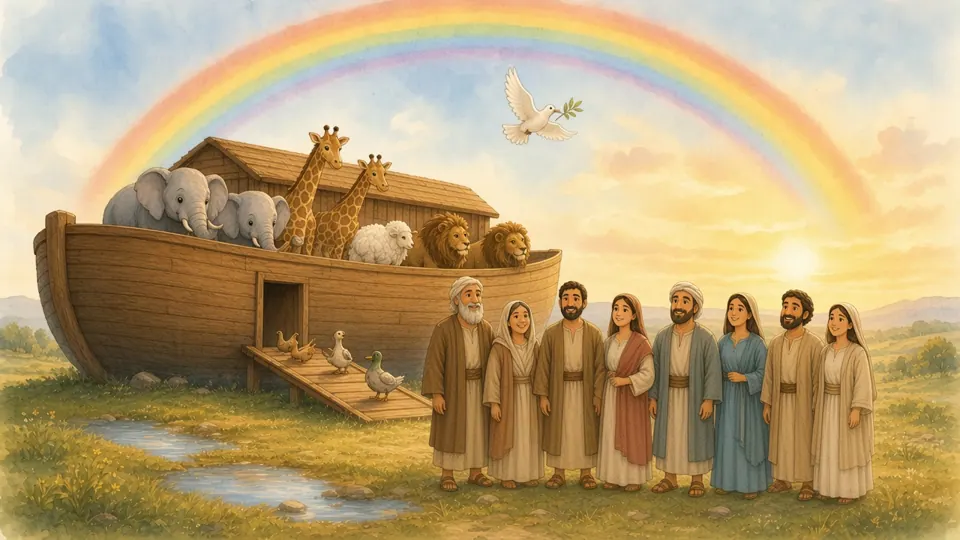
Noah's Ark and the Rainbow
Genesis 6:5–9:17
The Flood is one of the most famous stories in the world and one of the hardest. It's worth reading slowly.
Genesis 6 describes a world where violence and corruption have become normal. Human hearts were bent on evil constantly. God's reaction isn't rage; it's grief. He regrets, in human language, having made humanity, because what he made good has been ruined (Gen 6:6).
Noah is the exception: an upright man, faithful to God, in a corrupt age. God tells him a flood is coming and gives him precise plans for an ark, a huge wooden box-like vessel sealed with pitch. Noah does all of it. God promises to make a covenant with him. Noah, his wife, his three sons and their wives enter with pairs of animals, and God shuts the door.
The waters rise for forty days and keep rising until the mountains disappear. Everything that breathed on dry land outside the ark perishes. Genesis doesn't soften that. But the turning point of the story is a single line: God had not forgotten Noah (Gen 8:1). A wind blows, the waters recede, and the ark settles high in the Ararat mountains. A dove returns with a fresh olive twig, then doesn't come back at all.
Noah's first act on dry ground is to build an altar. Then God makes the first covenant explicitly named in Scripture, with Noah, his descendants, and all living things: never again will a flood wipe out all life. The sign is the rainbow.
What the Church sees here: the covenant with Noah is God's commitment to the whole human race, all the nations, and it remains in force until the Gospel goes out to all (CCC 56–58). The Flood also prefigures Baptism. Water brings an end to sin and a new beginning (CCC 1219; 1 Pt 3:20–21). The Church has long been compared to the ark, which saves from the flood (CCC 845).
Honest questions:
Did this happen exactly as written, worldwide? Catholics read Scripture according to the kind of writing it is and the intention of its human authors (Dei Verbum 12). Genesis 1–11 tells real truths about God and humanity in the style of ancient narrative. The Church does not require you to hold a particular scientific model of the Flood. What it does require is the story's meaning: sin is real and destructive, God judges, and God saves.
How can a loving God destroy so many? Scripture holds justice and mercy together. Sin has real consequences, and God takes evil seriously. But even here, he preserves a remnant, starts over, and binds himself by a promise. Peter says God waited patiently in Noah's day (1 Pt 3:20) and still does, not wanting anyone to be lost (2 Pt 3:9).
Why does God need a reminder? The rainbow is God speaking in human terms, a promise you can see, so we can trust him.
Talk about it
- The story says God was grieved by human violence. What does that show about how God sees sin?
- What is the significance of the line saying God had not forgotten Noah, in the middle of the story?
- How would you answer a friend who says the Flood shows God is cruel?
- Catholic connection: read CCC 1219. How does the Flood point to Baptism?
Key verse: Gen 9:13. Look it up in your Bible.
Illustrations created with Grok (AI) and reviewed by our team. Narration voice: Kokoro TTS (AI), Apache 2.0.