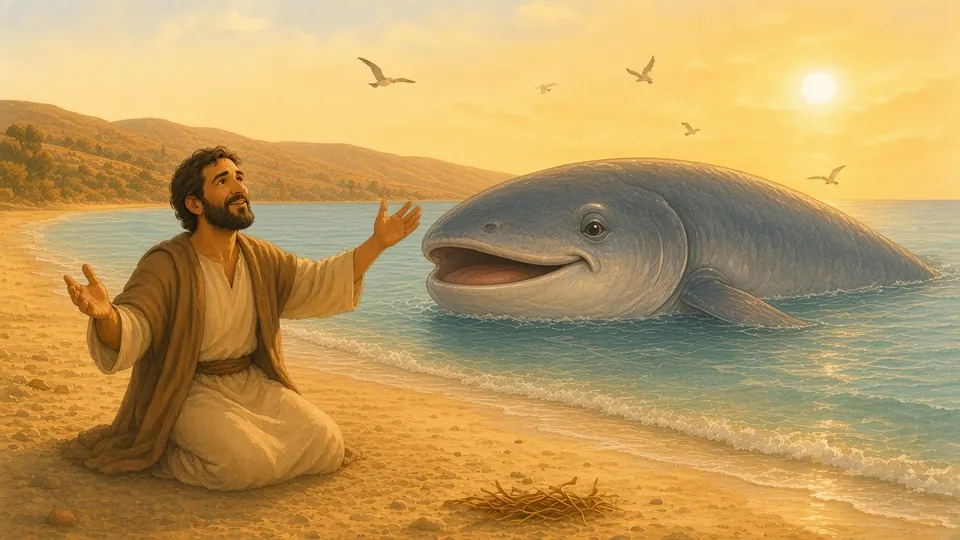
Jonah and the Great Fish
Jonah 1:1–4:11
Jonah, son of Amittai, was a prophet from the northern kingdom of Israel (2 Kgs 14:25). The book named after him tells what happened when God sent him to Nineveh, the capital of Assyria. The Assyrians were the superpower of the day, famous for their cruelty, and they would later conquer the northern kingdom in 722 BC. To Jonah, Nineveh was the enemy.
God told Jonah to go and announce judgment on the city, because the city's cruelty had grown too great to ignore. Jonah went the other way. At the port of Joppa he boarded a ship bound for Tarshish, a distant port far to the west, often thought to be in Spain, though no one knows for sure.
God sent a violent storm. The pagan sailors prayed to their gods and lightened the ship, while Jonah slept in the hold. When they drew lots to find out who had brought this trouble on them, Jonah's name came up. He admitted who he was: a Hebrew who served the Lord, the God who made everything, the sea included, and he was running away from him. He told them to throw him overboard. The sailors fought to row back to shore, then prayed that they would not be guilty of his death, and finally did as he asked. The sea went still, and the sailors, amazed, worshiped the Lord.
A great fish, sent by God, swallowed him. For three days and three nights Jonah was inside it, and there he prayed a psalm of thanksgiving, remembering how he had sunk into the deep and how God had heard him. Then, at God's word, the fish returned Jonah to the beach.
A second time, God sent Jonah to Nineveh. His whole message, just five words in Hebrew, gave the city forty days before its downfall. To everyone's surprise, the city took God's warning to heart. The people fasted and wore sackcloth, the rough cloth of mourning. Even the king joined in, sitting in ashes in place of his throne, and he ordered every person, and even the animals, to fast and to call on God and give up violence. God saw their change of heart and did not bring the disaster.
Jonah was furious. He told God that this was exactly why he had run: he had always known that God would rather forgive than punish. He sat outside the city to see what would happen. God made a leafy plant grow to shade him, then sent a worm to kill it and a hot wind to beat on him. Jonah was angry enough to want to die. God pointed out that Jonah was grieving over a plant he had done nothing to grow. Then he asked Jonah to think about Nineveh: more than a hundred and twenty thousand people who did not know any better, and their animals too. Did God not have every reason to care about them? The book ends with that question.
Jesus later pointed to Jonah's three days inside the fish as a sign of his own three days in the tomb before he rose (Mt 12:40). And he held up Nineveh's repentance as an example for his own listeners (Lk 11:32).
Talk about it
- Why did Jonah run away instead of going to Nineveh?
- What does God's question at the end show about how God sees people and animals?
- Jonah was angry that God forgave his enemies. Why is it hard to want good things for people we don't like?
Key verse: Jon 4:11. Look it up in your Bible.
Illustrations created with Grok (AI) and reviewed by our team. Narration voice: Kokoro TTS (AI), Apache 2.0.