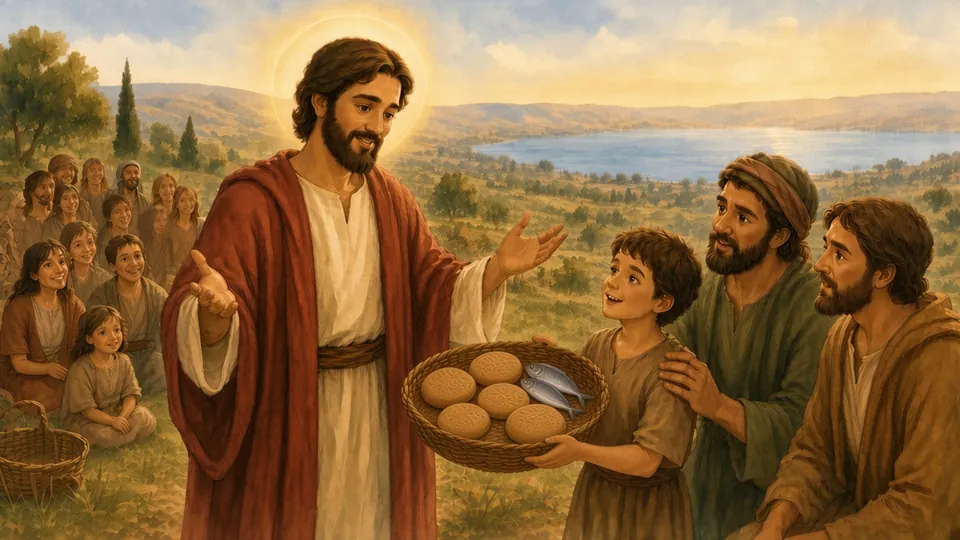
Jesus Feeds Five Thousand
John 6:1–15
The feeding of the five thousand is the only miracle, apart from the Resurrection, that appears in all four Gospels. John's version (Jn 6:1–15) has details the others don't, and it leads straight into one of Jesus' most important teachings.
The setting: Jesus crosses to the far side of the Sea of Galilee. A large crowd follows because they've seen his signs of healing. He and his disciples settle on a hillside. John adds a time stamp: Passover was near. That matters. Passover recalled how God freed Israel from Egypt and then fed them in the desert with manna, bread from heaven (Ex 16).
Seeing the crowd, Jesus asks Philip where they could buy bread for all these people. John tells us Jesus already knew what he would do; he was testing Philip. Philip calculates that two hundred denarii, roughly eight months of a laborer's wages, would fall far short of feeding this crowd. Andrew points out a boy with five barley loaves and two small fish, then adds, honestly, that it's nothing for a crowd that size. Barley bread was the cheap bread of the poor.
Jesus has the people sit down on the grass, about five thousand men. Then he takes the loaves, gives thanks, and distributes them, and the fish too, as much as anyone wants. The Greek word for giving thanks here, eucharisteo, is the root of our word Eucharist.
Afterward Jesus has the disciples collect the leftovers; he doesn't want any of it thrown away. The scraps fill twelve baskets. Some readers see one basket for each of the twelve tribes of Israel, or for each of the twelve apostles. Either way, God gives more than enough.
The crowd's reaction is excited and mistaken. They decide Jesus must be the Prophet that Moses had promised (Deut 18:15), and they are ready to crown him king, whether he wants it or not. Many people then hoped for a Messiah who would drive out the Romans and fill everyone's stomachs. Jesus slips away from them, up into the hills, on his own. He is a king, but not that kind (Jn 18:36).
The next day, in the synagogue at Capernaum, Jesus explains what the sign meant. He himself is the Bread of Life, the true bread from heaven, greater than the manna. He promises to give his own flesh to eat and his blood to drink, the way to eternal life (Jn 6:35, 51–58). Many followers find this too hard and leave, and Jesus does not soften it.
The Church sees the feeding as a sign pointing to the Eucharist (CCC 1335; 1338). At every Mass, Jesus still takes ordinary bread, gives thanks, and gives it to his people, but now the bread becomes his own Body, food for eternal life.
Talk about it
- Why do you think John mentions that Passover was near?
- What did Jesus do with the boy's small gift, and what does that say about what we offer God?
- Why did Jesus refuse to let the crowd make him king?
- How does this story point to the Eucharist?
Key verse: Jn 6:11. Look it up in your Bible.
Illustrations created with Grok (AI) and reviewed by our team. Narration voice: Kokoro TTS (AI), Apache 2.0.