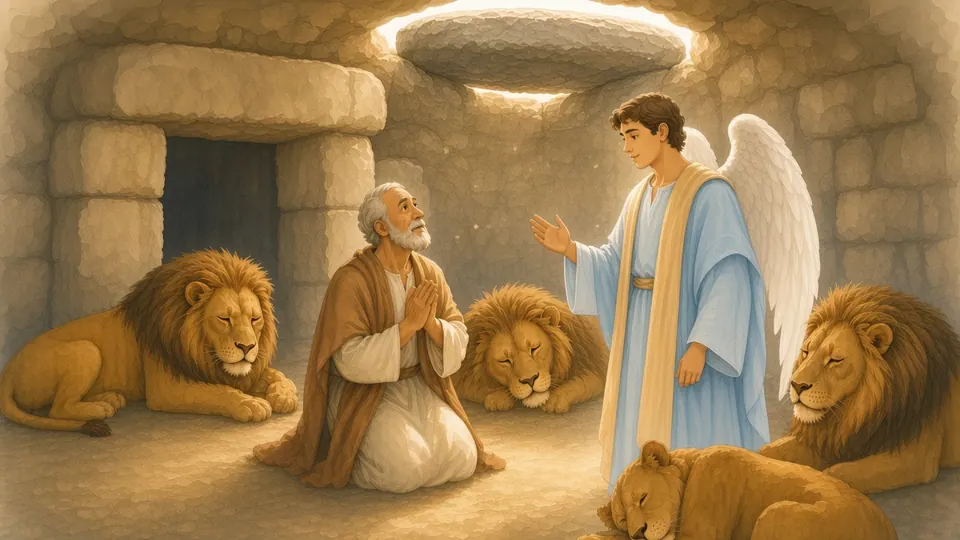
Daniel in the Lions' Den
Daniel 6:1–28
Daniel 6 is a story about faith under pressure from the government, and it is one of the best-loved stories of the Old Testament. It belongs to the part of the book written in Aramaic (Dan 2:4–7:28), the international language of the Persian empire.
The story: under King Darius, the elderly Daniel is one of three top officials over the empire's governors, and the king plans to promote him over everyone. His rivals can find no corruption in his work, so they target his faith. They flatter Darius into signing a thirty-day decree: the king alone may receive prayers, on pain of the lions' den, and not even the king can undo it. Daniel simply keeps his habit of prayer, three times a day, facing Jerusalem, exactly as before. He is reported and thrown to the lions, while the trapped king hopes aloud that Daniel's God will save him. A stone seals the den. After a sleepless night the king finds Daniel alive; an angel sent by God has protected him. Darius then throws the accusers and their families to the lions, and orders his whole empire to honor Daniel's God.
What the Church sees here: Daniel is a model of conscience. The Catechism teaches that a citizen must refuse a civil command that contradicts the moral order or the Gospel, and cites the apostles' answer that God comes before any human authority (CCC 2242; Acts 5:29). Disciples are called not only to keep the faith but to profess it openly (CCC 1816). And Daniel's fixed hours of prayer resemble the rhythms the Church still proposes: morning and evening prayer and the Liturgy of the Hours (CCC 2697–2698).
Honest questions:
Should Christians break laws? Only laws that require us to do wrong (CCC 2242). Daniel didn't riot or hide; he kept praying, openly, and accepted the consequences.
Why were the accusers' families killed? The text reports a pagan king's decree; it doesn't hold it up as God's justice. God's own law forbade punishing children for their parents' crimes (Deut 24:16; Ez 18:20).
Does God always rescue the faithful like this? No, and Scripture knows it. In Daniel 3, the three young men tell the king that God is able to save them, but that their refusal to worship his statue does not depend on being rescued (Dan 3:17–18). Many martyrs were not saved from death; martyrdom is the supreme witness to the faith (CCC 2473). Daniel's rescue points beyond itself to the hope of resurrection (Dan 12:2).
Did it happen? No ruler named Darius the Mede is known outside the Book of Daniel, and historians have proposed several identifications. Many Catholic scholars read Daniel 1–6 as inspired stories of faithful Jews at foreign courts. The Church has not defined their literary form and reads them with attention to the conventions of their time (CCC 110).
Early Christians painted Daniel among the lions in the Roman catacombs as a sign of hope, and Christian tradition has long seen in the sealed den opened at dawn a figure of Christ's tomb (St. Hippolytus of Rome, writing in the early 200s, already compared the sealing of the den with the sealing of Jesus' tomb; Mt 27:66); this is a reading from Tradition, not the literal sense (CCC 128–130).
Talk about it
- Daniel kept praying openly when it was illegal. Where might faith cost you something today?
- How would you answer a friend who asks why God rescued Daniel but not every martyr?
- What is the difference between Daniel's quiet faithfulness and a loud protest?
- Catholic connection: read CCC 2242. When must a Christian refuse to obey a law?
Key verse: Dan 6:22. Look it up in your Bible.
Illustrations created with Grok (AI) and reviewed by our team. Narration voice: Kokoro TTS (AI), Apache 2.0.