God Makes the World
Genesis 1:1–2:3
Genesis 1 is the opening scene of the whole Bible, and it answers the biggest questions first: Where did everything come from? Why is it here? Who are we?
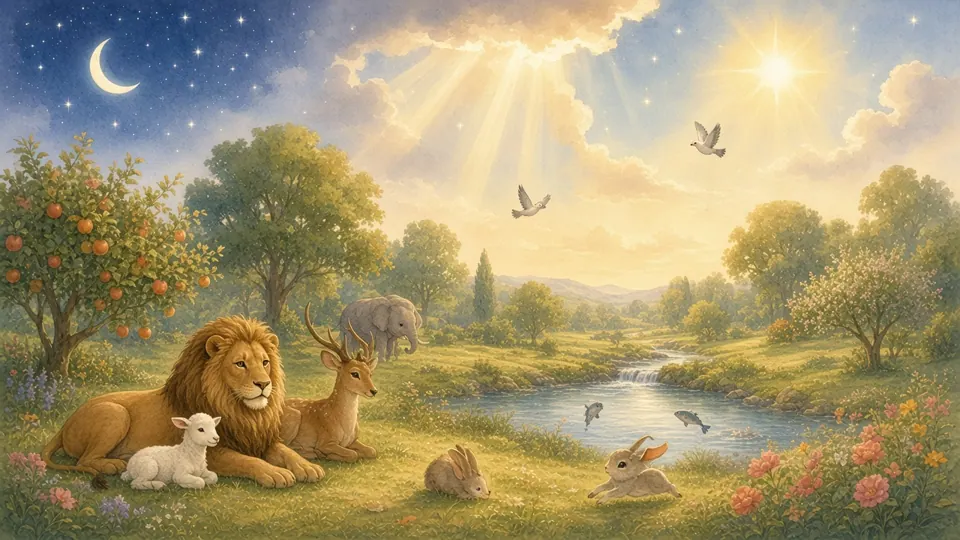
The story starts with God alone. Then God creates, not by shaping something that already existed, but by calling everything into being from nothing. Before the first day, the earth is pictured as a shapeless, dark, flooded emptiness. Then, day by day, God speaks and things happen. Light. A sky that separates the waters. Seas gathered so land appears, and the land sprouting plants that carry seed. Sun, moon and stars. Sea creatures and birds. Land animals. And finally, human beings.
Each step follows the same rhythm: God speaks, it happens, God names or blesses it, God approves it, and the day closes. The repetition is deliberate. It sounds almost like a hymn, and it teaches that creation is orderly, intentional and good.
Notice what Genesis does with the sun, moon and stars. Many of Israel's neighbors worshiped them as gods. Genesis presents them as lights God placed in the sky to mark days, seasons and years. They are creatures, not rulers. The same goes for the great sea creatures some ancient stories feared: God made them, too.
Then the high point: God creates human beings, male and female, and makes them like himself in a way nothing else is. He blesses them, tells them to have children and fill the earth, and gives them responsibility over the other creatures. That's not permission to exploit. It's a share in God's own care for the world.
At the end of the sixth day, God looks at the whole of creation and finds it supremely good. On the seventh day God rests and makes that day holy.
Honest answers to common objections:
Doesn't science disprove Genesis? The Church teaches that real science and real faith can't contradict each other, because the same God made the world and gave us reason (CCC 159). Genesis isn't a science textbook. It is inspired truth about who made the world and why. The Catechism says Scripture presents God's work of creation symbolically, as six days of work followed by rest (CCC 337). Catholics are free to study the age and development of the universe scientifically. What Catholics hold firmly is this: God created everything from nothing, freely and out of love; creation is good; and every human being is made in God's image, with a spiritual soul (CCC 296, 299, 355–357, 366).
Why does it matter? If you are made in God's image, your worth doesn't depend on looks, grades, followers or what anyone says about you. And neither does anyone else's.
Talk about it
- What happens on each of the six days, and what pattern ties them together?
- Genesis treats the sun, moon and stars as created things, not gods. What do people today sometimes treat as gods instead of as gifts?
- How would you answer a friend who says science has disproved the Bible?
- Catholic connection: read CCC 355–357. What does being made in God's image say about your worth and everyone else's?
Key verse: Gen 1:27. Look it up in your Bible.
Illustrations created with Grok (AI) and reviewed by our team. Narration voice: Kokoro TTS (AI), Apache 2.0.