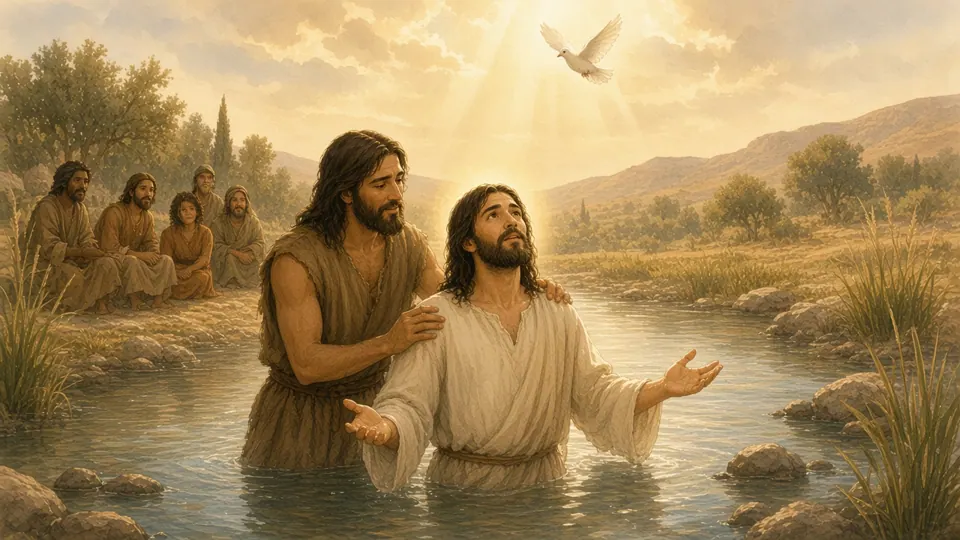
Jesus Is Baptized
Matthew 3:13–17
The baptism of Jesus is a strange scene if you stop and look at it. The one person in history with nothing to confess wades into a river with people confessing their sins. Matthew alone records the conversation that explains why (Mt 3:14–15).
Context: John the Baptist preached in the Judean wilderness near the Jordan, a place heavy with memory. Israel crossed the Jordan into the Promised Land (Josh 3), and Elijah, whose rough clothing John's resembled, was taken up to heaven near it (2 Kgs 1:8; 2:7–11). Washing rites were common in the Judaism of the time, but John's baptism was a single, public act of repentance in view of God's coming judgment and kingdom. Jesus, about thirty years old (Lk 3:23), came from Galilee to receive it.
The story: John resists, saying he needs Jesus' baptism rather than the reverse. Jesus answers that this is what obedience to God's will asks of him, and he intends to obey in everything. As Jesus rises from the water, the heavens open, the Spirit of God comes down in the form of a dove and rests on him, and the Father's voice from heaven names him his own dearly loved Son, the joy of his heart. Those words echo two Old Testament texts at once: the royal Son of Psalm 2:7 and the chosen Servant of Isaiah 42:1, on whom God puts his Spirit.
The Church's reading: at the Jordan, Jesus accepts his mission as the Servant who will bear the sins of many, and he anticipates the 'baptism' of his death (CCC 536). The Spirit rests on him as Messiah (CCC 1286), and the Father reveals his divine Sonship (CCC 444). The Church celebrates the scene as one of the great moments of Christ's manifestation, together with the Epiphany and the wedding at Cana (CCC 528). Baptism unites us to him: we go down into the water with Christ and rise with him to new life (CCC 537; Rom 6:3–4).
For adult life, three things.
Identity before achievement. The Father speaks his delight before Jesus has preached a sermon or worked a miracle. Many adults live as though their worth must be earned through work, success, parenting or ministry. Baptism says the reverse: you are God's child first, by grace, and your work flows from that, not toward it (CCC 1996).
Solidarity. Jesus stands in line with sinners. Christians who want to help others, in family, parish or community, are called to the same humble closeness, not superiority.
A baptismal life. For many Catholics, Baptism is a photo in an album. The Church treats it as the foundation of the whole Christian life and the doorway to the other sacraments (CCC 1213). Renewing your baptismal promises at Easter, blessing yourself with holy water as you enter church, and taking seriously a role as parent or godparent are ways to live it.
St. Louis IX, king of France, is said to have prized his baptism more than his coronation, because the crown would pass away, while Baptism made him a child of God forever.
A real-life step: learn your baptismal date and mark it on your calendar, or call your godparents. If you are a parent or godparent, tell a child the story of their Baptism.
Talk about it
- In what part of your life are you tempted to earn your worth instead of receiving it as a gift?
- What does Jesus standing in line with sinners say about how to treat people who struggle?
- How could your own Baptism become more present in your daily life?
- Catholic connection: read CCC 1213 and 1265. Which line surprises you?
Key verse: Mt 3:17. Look it up in your Bible.
Illustrations created with Grok (AI) and reviewed by our team. Narration voice: Kokoro TTS (AI), Apache 2.0.