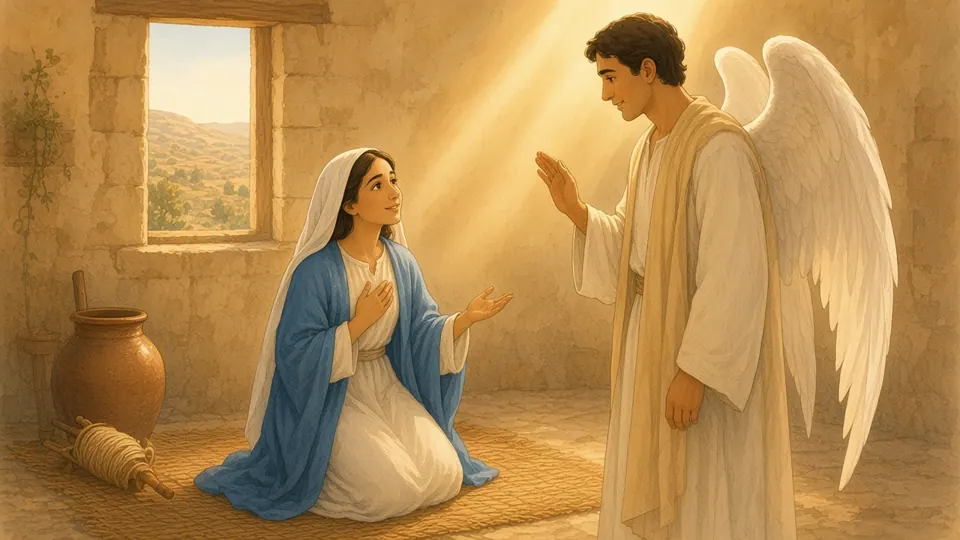
Mary Says Yes to God
Luke 1:26–56
Luke's Gospel begins with two announcements from the angel Gabriel. First he appears to an old priest, Zechariah, in the Temple in Jerusalem, promising that his wife Elizabeth will bear a son, John (Lk 1:5–25). Six months later Gabriel is sent to a very different place: Nazareth, a small village in Galilee, to a young woman named Mary. She is betrothed to Joseph, a descendant of King David. In that culture betrothal was a binding agreement, though the couple did not yet live together.
Gabriel's greeting is astonishing: God is with Mary, and she has been filled with his grace. Mary is deeply shaken, and puzzled. Gabriel reassures her and explains: God has chosen her to be the mother of a son, whose name is to be Jesus, a name that means God saves. He describes the child in the language of God's old promises to David, a king from David's family whose kingdom would never end (2 Sam 7:12–16), and more than that, the Son of the Most High.
Mary's question is honest and practical: she is still a virgin, so how is this going to happen? Gabriel explains that no human father will be involved: the Holy Spirit will bring it about by God's own power, and the child will be God's own holy Son. As a sign, he tells her that her elderly relative Elizabeth is already six months pregnant. There is no limit to what God can do.
Then Mary gives her answer: she places herself entirely at God's service and agrees to his plan. The Church calls this answer Mary's fiat, a Latin word meaning let it be done.
Mary then travels quickly to Elizabeth's home in the hill country of Judah, a journey of several days. At the sound of Mary's greeting, the unborn John stirs with joy, and Elizabeth, filled with the Holy Spirit, praises Mary for believing, greets her as the mother of her Lord, and blesses both her and her child. Even before he is born, John is pointing to Jesus.
Mary answers with a song of praise known as the Magnificat (Lk 1:46–55). It turns the world's ranking upside down: in God's way of doing things, the proud and powerful lose their place, while the poor and hungry are raised up and fed. She praises God for remembering his promise to Abraham, and she foresees the honor every later age will give her, not for her own sake but for what God has done in her. Her song sounds a lot like the song of Hannah, Samuel's mother (1 Sam 2:1–10).
Mary stays about three months and then returns home.
This is the moment God the Son became man, which is why the Church calls Mary the Mother of God. Christians remember it every time they pray the Hail Mary, which begins with Gabriel's and Elizabeth's greetings.
Talk about it
- What did Gabriel tell Mary about who her son would be?
- Why do you think Mary's yes mattered so much in God's plan?
- Mary hurried to help Elizabeth. How can you help someone in your family who needs it?
Key verse: Lk 1:38. Look it up in your Bible.
Illustrations created with Grok (AI) and reviewed by our team. Narration voice: Kokoro TTS (AI), Apache 2.0.